Water-screen projection exposes AV equipment to more than ordinary rain: wind-driven mist, splash, high humidity, condensation, optical-window fogging, mineral residue, corrosion, cable-entry risk, and the heat load of high-brightness projectors. A suitable water screen projector enclosure may require sealing, thermal management, dew-point control, protected cable routing, drainage, optical-glass alignment, corrosion-resistant construction, and service access—without assuming one cooling design fits every site.
Video Guide: See how smoke testing visualizes the airflow path inside an outdoor projector enclosure.
What is water screen projector enclosure?
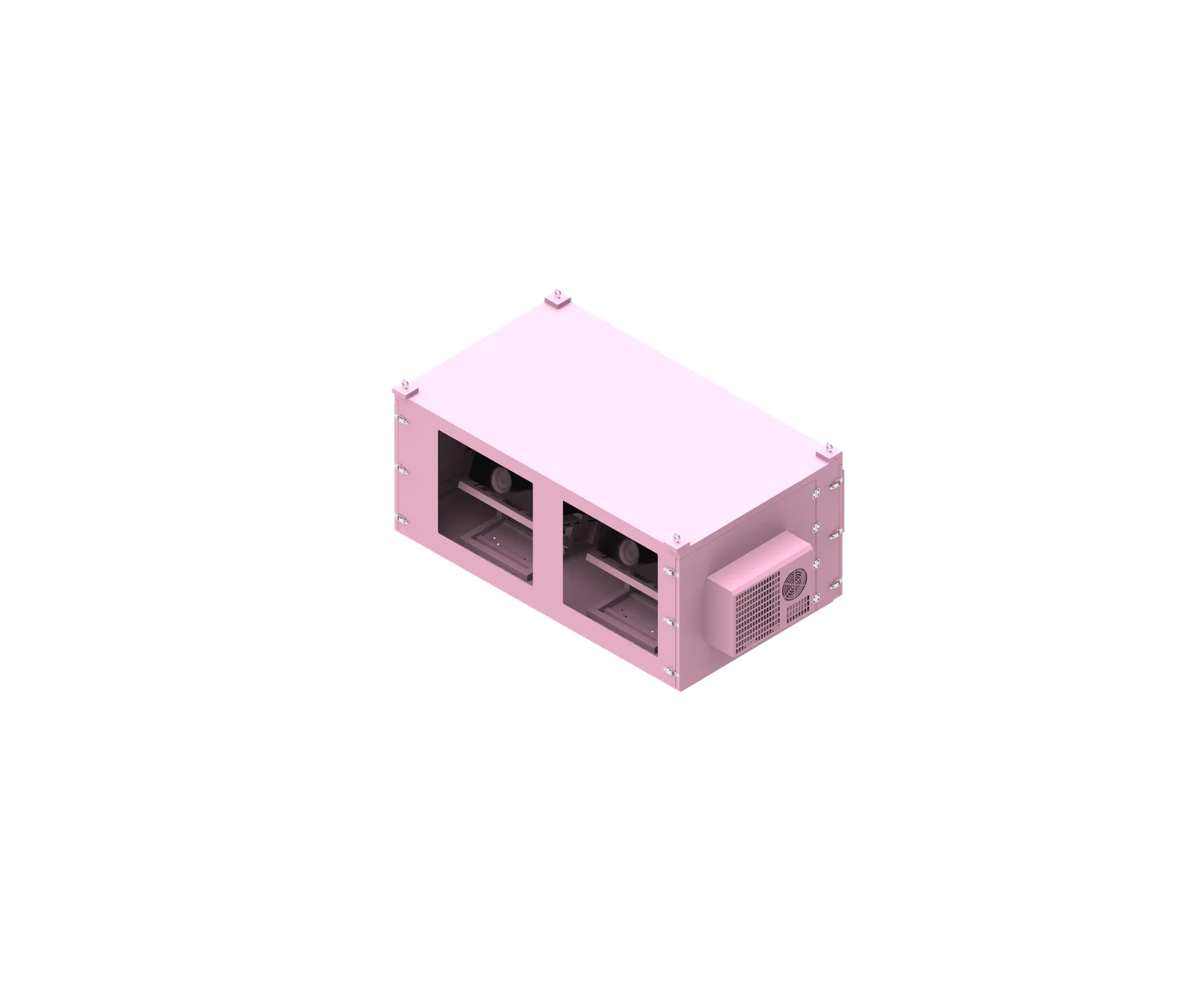
A water screen projector enclosure is an outdoor environmental housing that protects and thermally manages a projector used for water-screen, water curtain, fountain show, lake show, or similar projection. It is not the water-screen generator itself; it protects the projector, lens area, cable interfaces, and related control hardware from site-specific outdoor risks.
Video Guide: Take a closer look at the design of an outdoor projector enclosure.
Purpose and Application Scope
A basic rain cover is usually insufficient for permanent water-screen projection because the projector may remain outdoors before, during, and after fountain operation. The enclosure must address normal rainfall, airborne mist, splash, humidity, optical-glass residue, and heat removal from the projector.
Typical applications include:
- Water-screen projection beside rivers, lakes, or pools
- Water curtain projection in cultural-tourism night shows
- Musical fountain projection
- Theme-park and scenic-area shows
- Multi-projector panoramic water-screen installations
- Permanent outdoor projection mapping near water features
A water-screen projection enclosure protects the projector and associated equipment; it does not create the water screen, control the fountain pumps, or generate media content.
ShiRui Pro Tip: I always separate “projector protection” from “water-show equipment” during early design meetings. If the enclosure is treated as an afterthought, cable routing, lens position, cooling, and maintenance access often become expensive site problems later.
How Does water screen projector enclosure Work?
A water screen projector enclosure works by combining environmental sealing, controlled airflow or climate control, humidity management, optical-window protection, sealed cable entry, drainage, and service access. The goal is to keep the projector within manufacturer operating limits while reducing exposure to mist, splash, dust, insects, corrosion, and condensation.
Environmental Protection Process
The enclosure must manage two different risks: external water entering from rain or mist, and internal moisture condensing after temperature changes. These are related but not the same. IP protection can reduce water ingress, but it does not automatically prevent condensation inside a sealed or semi-sealed cabinet.
A typical engineering sequence includes:
- Confirm the exact projector model, lens, weight, dimensions, intake location, exhaust location, power consumption, and heat-dissipation data.
- Evaluate site temperature, humidity, wind direction, spray direction, rainfall exposure, and flood risk.
- Select filtered fresh-air cooling, hybrid cooling, or sealed/mostly closed-loop climate control.
- Position the optical window to avoid beam clipping, internal reflection, and lens-shift conflict.
- Design cable glands, drip loops, drainage paths, and maintenance access.
- Add sensors, alarms, anti-condensation heating, dehumidification, or standby environmental control when required.
The environmental controller may need power even when the projector is off, because shutdown periods often create dew-point risk.
ShiRui Pro Tip: I do not judge enclosure cooling by projector brightness alone. I start with the manufacturer’s heat-dissipation data, then check humidity, solar load, operating schedule, and whether outside-air exchange is acceptable near the water screen.
What is the best outdoor waterproof projector box?
The best outdoor waterproof projector box for water-screen projection is not simply the highest IP-rated box. It is a projector-specific enclosure that balances ingress protection, cooling, condensation control, optical-window design, cable sealing, drainage, corrosion resistance, and maintenance access for the exact site and projector configuration.
IP65 Protection and Practical Limits
Based on our internal data and market analysis, here is the breakdown:
| Protection Area | What It Helps With | Important Limitation |
|---|---|---|
| Door gaskets | Rain and dust reduction | Poor installation or aging seals can reduce protection |
| Cable glands | Power and signal cable sealing | Field-drilled openings may affect the original rating |
| Optical-window seals | Protection around the beam exit | Window fogging and mineral residue still need control |
| Vent interfaces | Air exchange where used | Vents can admit humid air or mist if poorly protected |
| Drain outlets | Water or condensate removal | Drain design must avoid reverse water entry |
| Locks and hinges | Mechanical closure integrity | Corrosion resistance depends on material and environment |
| Air-conditioning interfaces | Climate-control connection | Cooling capacity is not proven by IP rating |
ShiRui’s third-party test report for an intelligent climate-controlled enclosure identifies main test model shirui-12000, report number CTB200724004Q, standard GB/T 4208-2017, and test item IP65. The IPX5 water test used a 6.3 mm nozzle, 12.5 L/min flow rate, 2.5–3 m distance, and at least three minutes of testing, with no internal water ingress. The IP6 dust test lasted eight hours, with no dust found inside the tested sample.
However, IP65 does not mean immersion-proof, flood-proof, salt-spray resistant, condensation-proof, or cooling-capable. Customized doors, vents, windows, drains, cable glands, and AC openings must be reviewed as part of the complete enclosure design. For more detail, see the internal article IP54 vs IP65 Projector Enclosure.
ShiRui Pro Tip: I treat IP65 as one verified protection reference, not the whole specification. For water-screen sites, dew point, airflow path, cable entry, and optical-window cleaning can be just as important as water-jet resistance.
What is the best projector for outdoor projection mapping?
For a water-screen projection enclosure, the “best projector” is the model whose brightness, lens options, heat output, size, weight, airflow direction, and manufacturer environmental limits match the project. Enclosure design should use official projector specifications, not assumptions based on lumen class or previous installations.
Projector Data That Drives Enclosure Engineering
The Christie D20WU-HS provides a useful model-specific example because official Christie data lists normal-mode power consumption at 1,710 W, heat dissipation at 5,835 BTU/hr, dimensions without feet at 677 × 596 × 203 mm, weight at 41.6 kg, operating temperature at 0–40°C, and operating humidity at 10–85% non-condensing.
These values should be treated as official manufacturer data for that model, not as ShiRui laboratory measurements and not as universal values for every 20,600-lumen projector.
Based on our internal data and market analysis, here is the breakdown:
| Projector Information | Why It Matters for the Enclosure |
|---|---|
| Exact model | Determines size, thermal load, airflow, and service clearance |
| Lens model | Determines optical-window size, lens clearance, and throw geometry |
| Power consumption | Helps estimate internal heat load |
| Heat dissipation | Supports cooling architecture selection |
| Intake and exhaust direction | Prevents recirculation and overheating |
| Weight | Affects mounting structure, rails, and handling |
| Operating humidity | Defines non-condensing environmental limits |
| Operating temperature | Defines required internal temperature control |
ShiRui Pro Tip: I ask for the projector data sheet and the exact lens part number before drawing the enclosure window. A “20K projector” description is not enough for airflow, weight, or optical alignment decisions.
How to build an outdoor projector enclosure?
Building an outdoor projector enclosure for water-screen projection requires engineering review, not only sheet-metal fabrication. The design must account for projector heat, airflow direction, humidity, dew point, water mist, splash exposure, cable sealing, optical alignment, drainage, maintenance access, and local electrical safety requirements.
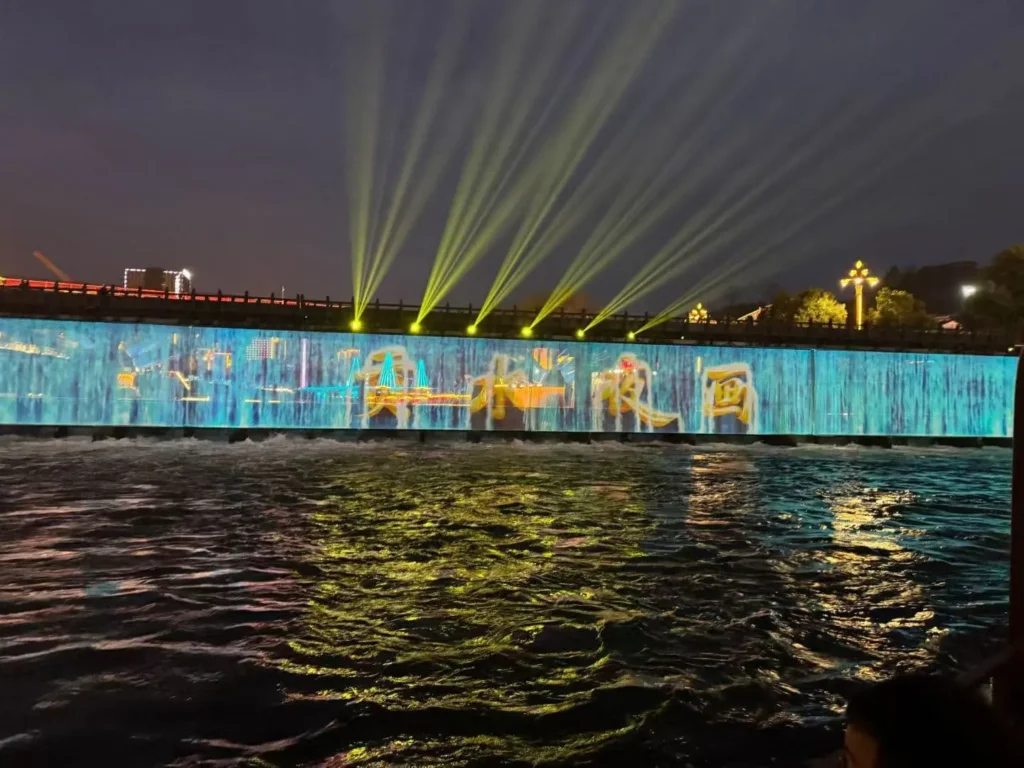
Design Information Required Before Fabrication
Based on our internal data and market analysis, here is the breakdown:
| Required Project Information | Why It Is Needed | Enclosure Design Area Affected |
|---|---|---|
| Projector brand and exact model | Confirms dimensions and thermal data | Cabinet size, cooling, mounting |
| Quantity | Defines individual or shared housing approach | Heat load, layout, power |
| Projector dimensions and weight | Prevents clearance and support errors | Structure and service rails |
| Power consumption and heat dissipation | Supports cooling selection | Fans, AC, closed-loop design |
| Exact lens model and throw ratio | Prevents beam clipping | Optical-window location |
| Water-screen width and height | Defines projection geometry | Lens alignment and throw |
| Mounting height and method | Affects structure and access | Pole, wall, ground, platform |
| Site temperature and humidity | Defines climate-control needs | Cooling and condensation control |
| Wind and spray direction | Predicts mist exposure | Vent and door orientation |
| Flood or standing-water risk | Protects base and cable entry | Drainage and elevation |
| Power and signal interfaces | Defines cable glands | Electrical layout |
| Site photos and structural drawings | Reduces installation risk | Mounting and service access |
Electrical design must follow applicable local codes and be completed or reviewed by qualified personnel. Universal cable sizes, breaker ratings, leakage settings, and grounding specifications should not be assigned without project-specific electrical data.
Recommended internal references include How Projector Airflow Direction Affects Enclosure Design, How to Align the Optical Window with the Projector Lens, and How to Plan Cable Entry for an Outdoor Projector Enclosure.
ShiRui Pro Tip: I do not recommend field-building a permanent water-screen enclosure without a reviewed drawing. Small errors in cable entry, window height, or airflow direction can cause leakage, overheating, or optical misalignment.
Key Features & Comparison
A water-screen projection enclosure should be evaluated as a complete environmental system: cabinet, seals, optical window, thermal control, humidity control, cable entry, drainage, mounting, and monitoring. The best configuration depends on the projector model, site conditions, operating schedule, exposure level, and acceptable maintenance access.
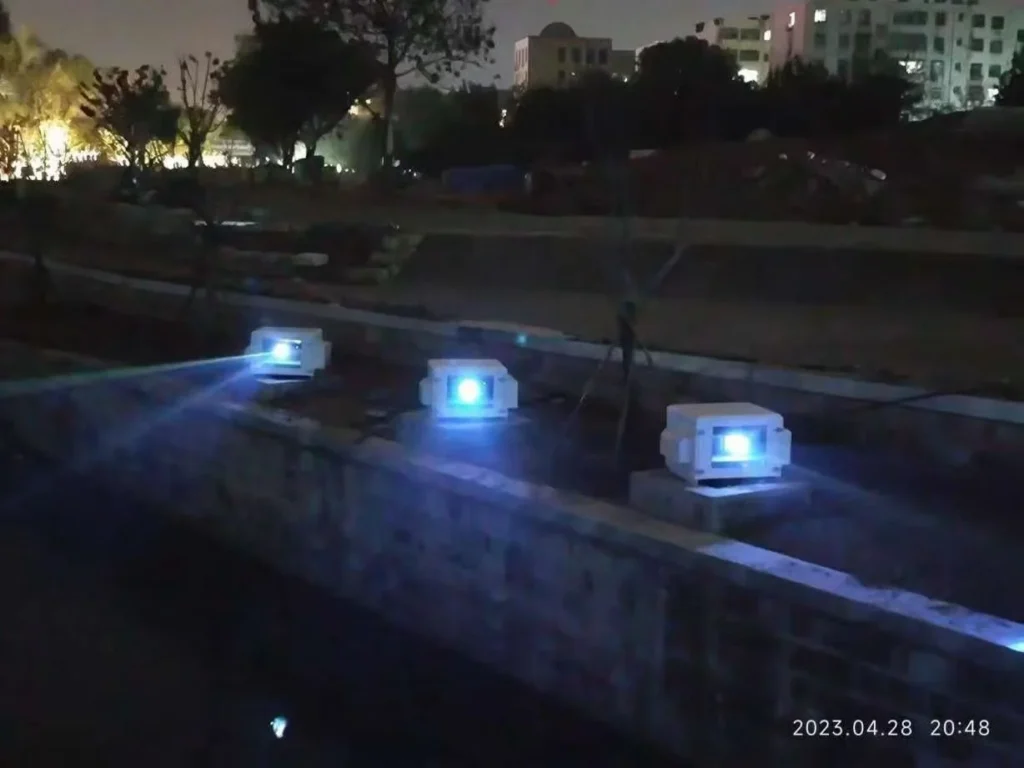
Cooling, Humidity, and Environmental Risk Comparison
Based on our internal data and market analysis, here is the breakdown:
| Environmental Risk | Why It Occurs at a Water-Screen Site | Required Enclosure Response |
|---|---|---|
| Wind-driven mist | Spray plume shifts with wind | Protected vents, sealed openings, site-aware placement |
| Direct splash | Fountain or water curtain spray reaches equipment | Gaskets, window seals, splash shielding |
| High humidity | Water surface and mist increase moisture level | Humidity monitoring, controlled air exchange |
| Nighttime condensation | Surfaces cool below dew point | Anti-condensation heating or dehumidification |
| Optical-window fogging | Inner or outer glass temperature changes | Window heating, airflow control, cleaning access |
| Dust and insects | Outdoor installation remains exposed | Filters, seals, inspection access |
| Mineral deposits | Water mist dries on glass and seals | Cleanable optical window and maintenance plan |
| Corrosion | Moisture and contaminants attack hardware | Coatings, suitable fasteners, inspection |
| Standing water | Rain, riverbank conditions, or drainage issues | Elevated mounting, base drainage |
| Electrical exposure | Cables pass into wet outdoor zones | Sealed glands, drip loops, grounding |
| Temperature swings | Day-night changes affect cabinet interior | Sensors and standby control |
| Difficult access | Pole or shoreline mounting limits service | Door direction, safe technician access |
Cooling options should be selected carefully:
| Cooling Approach | When It May Be Considered | Main Water-Screen Limitation | Information Required Before Selection |
|---|---|---|---|
| Filtered fresh-air cooling | Mild sites with acceptable outside-air exchange | May introduce humid air or mist | Ambient temperature, humidity, mist exposure, heat load |
| Fresh-air plus air conditioning | Sites needing added cooling but still allowing some air exchange | Vent protection remains critical | Projector heat, filter resistance, solar load |
| Sealed or mostly closed-loop climate control | Severe humidity, heavy mist, dust, corrosive air, long operation | Higher design complexity and condensate management | Internal target conditions, heat sources, maintenance plan |
Air conditioning is not mandatory for every water-screen project, and fan cooling is not suitable simply because a projector is below or above a certain lumen value.
ShiRui Pro Tip: I prefer to review the enclosure as one airflow-and-moisture system. Adding a fan, filter, or AC unit without checking vent location and dew-point behavior can create a new failure path.
Cost & Buying Factors
The cost of a fountain show projector enclosure depends on projector size, heat load, cooling architecture, IP protection target, optical-window complexity, corrosion protection, mounting method, remote monitoring, cable interfaces, and customization. Buyers should compare engineering scope, not only cabinet dimensions or a generic waterproof projector enclosure price.
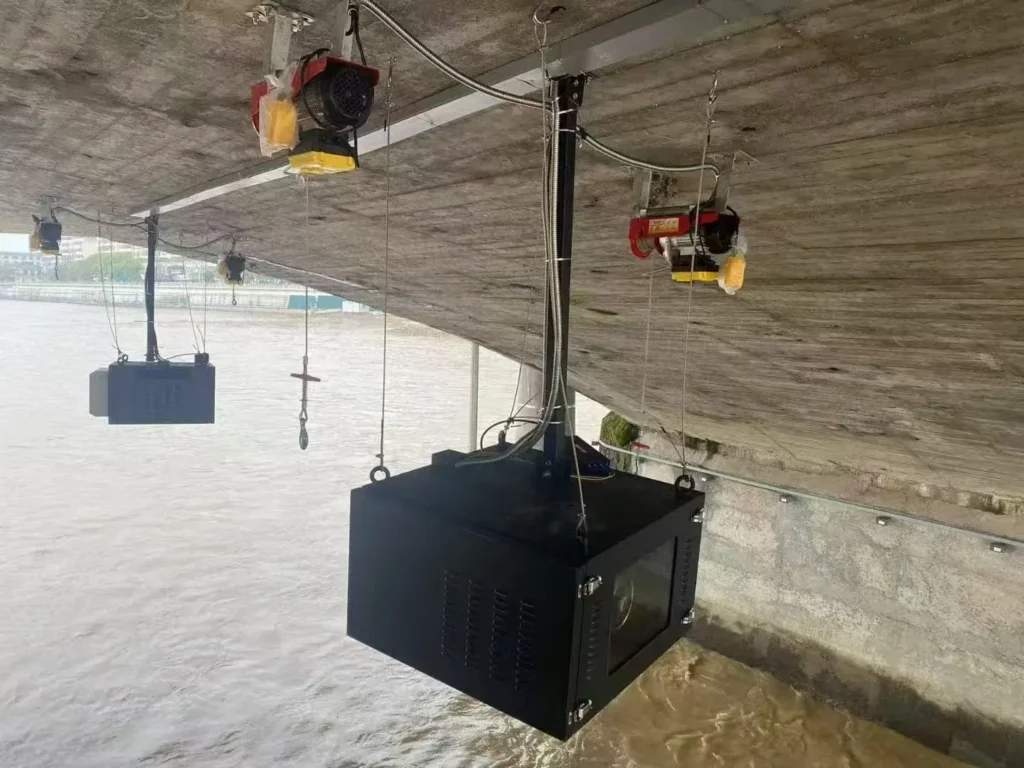
Commercial Evaluation Guide
Cost is usually driven by engineering complexity rather than enclosure volume alone. A climate-controlled projector enclosure for a high-humidity water-screen site may require custom internal brackets, larger optical glass, environmental controllers, alarms, condensate paths, and corrosion-resistant hardware.
Key buying factors include:
- Exact projector and lens compatibility
- Cooling architecture and calculated thermal margin
- Condensation-control strategy
- IP test reference and customization impact
- Optical-window position, size, and serviceability
- Cable-entry layout for power, fiber, HDMI, SDI, network, and control
- Drainage and condensate management
- Mounting method: pole, ground, wall, rooftop, or platform
- Remote temperature and humidity monitoring
- Access for filters, glass cleaning, fans, AC service, and cable inspection
- Documentation quality, drawings, and production approval process
For water-screen projects, buyers should also budget for site coordination. The enclosure may need to align with structural steel, projector throw distance, riverbank access, safe maintenance zones, and the water-screen operating schedule.
ShiRui Pro Tip: I advise buyers not to compare only “box price.” Ask whether the quotation includes projector-specific airflow review, optical-window drawing, cable-gland plan, condensation control, and mounting interface details.
Site Placement, Multi-Projector Planning, and Project Reference
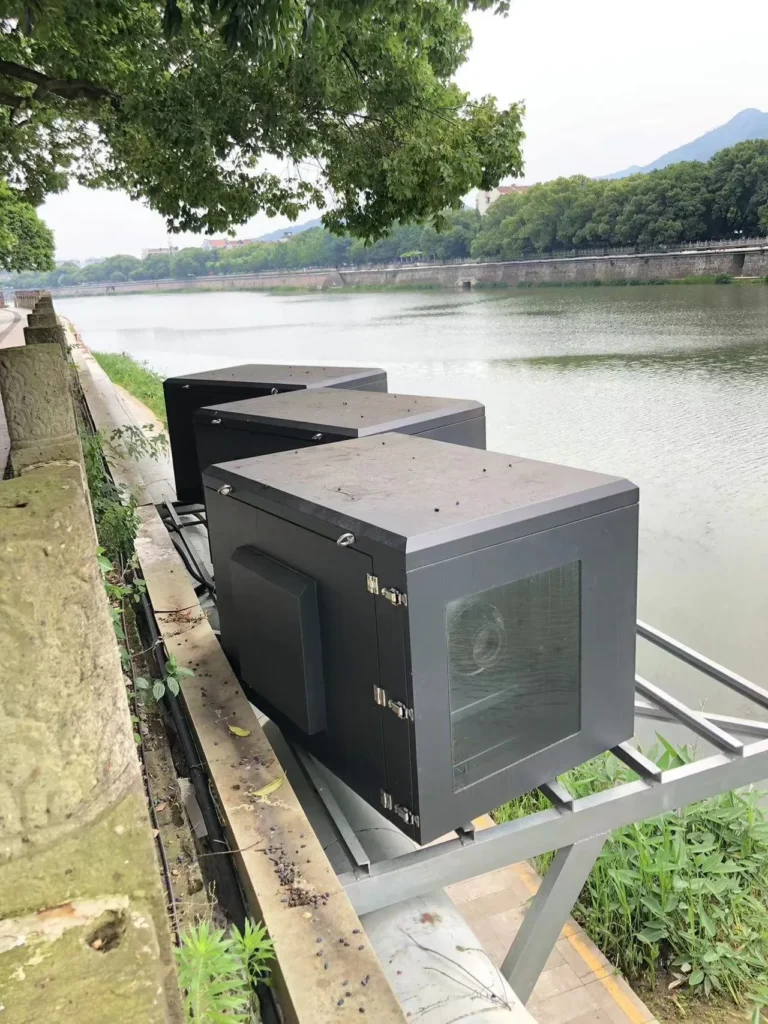
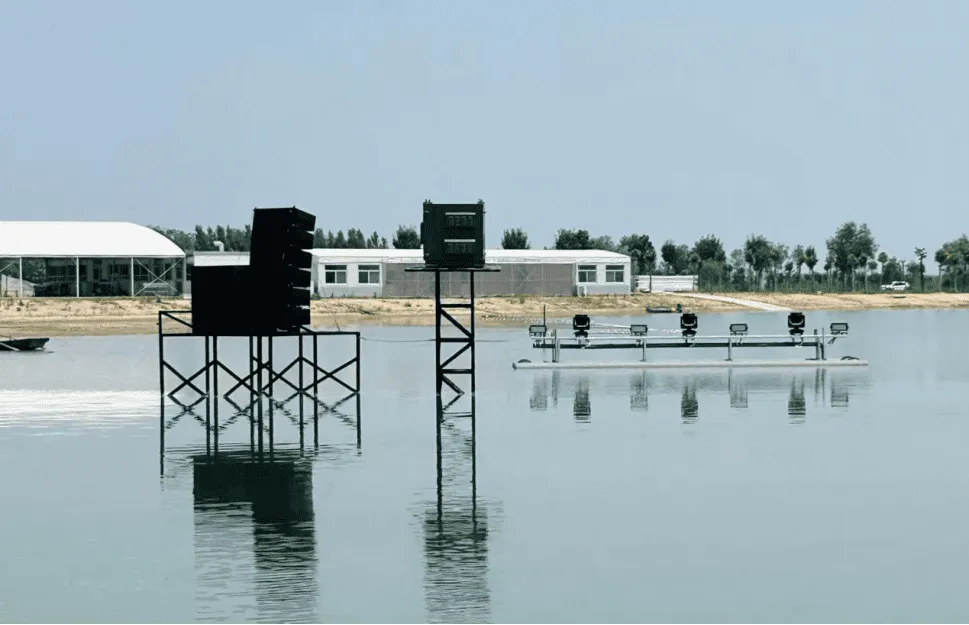
Water-screen enclosure placement depends on throw distance, lens selection, screen size, wind, spray pattern, mounting structure, water level, flood risk, and technician access. There is no universal minimum safe distance between a projector enclosure and a water screen; placement must be engineered for the specific site.
Yinchuan Water-Screen Project Snapshot
This project is useful because it shows why enclosure design must consider shoreline installation, vertical pole mounting, telephoto lenses, maintenance access, and multiple projector positions. It should not be used to infer ShiRui’s exact contractual scope, enclosure quantity, cooling method, IP rating, pole height, throw distance, internal operating temperature, operating hours, maintenance history, or customer testimonial.
Multi-projector water-screen projects require additional planning:
- Decide whether projectors use individual or shared enclosures.
- Review each projector’s heat load independently.
- Preserve optical alignment and image blending access.
- Plan power distribution, network control, and remote monitoring.
- Consider spare or redundant projector strategy.
- Confirm pole and foundation loading with qualified structural professionals.
- Coordinate maintenance so one enclosure can be serviced without disrupting the full show where possible.
Five projectors rated at 20,600 lumens each should not be simplified into a guaranteed water-screen brightness figure. Final image brightness depends on settings, lens transmission, overlap, image processing, water density, screen stability, ambient light, optical glass, and measurement method.
ShiRui Pro Tip: In multi-projector layouts, I confirm service-door swing, technician standing position, and cable access before production. Alignment accuracy is important, but maintainability determines how well the system survives real outdoor operation.
Corrosion, Cleaning, and Maintenance
Water mist can leave residue on optical glass, seals, fasteners, hinges, painted surfaces, filters, and cable glands. Long-term reliability depends on material selection, coating quality, inspection access, drainage, filter service, sensor checks, and routine cleaning—not on an IP rating alone.
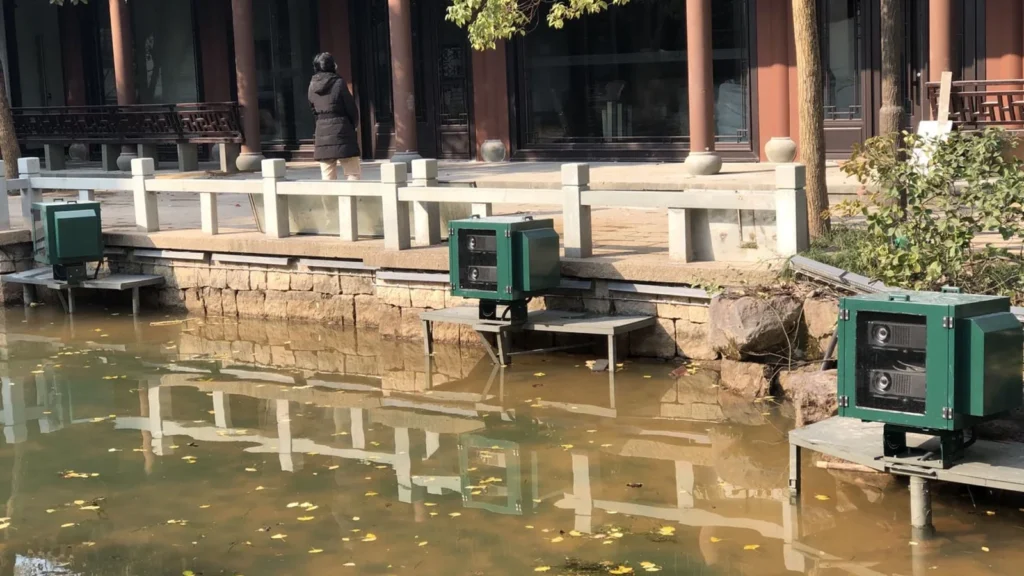
Practical Maintenance Priorities
Water-screen sites often create a combination of moisture, dust, insects, mineral residue, heat, and daily temperature changes. Even a well-designed weatherproof projector housing needs inspection because seals age, filters load with dust, and optical windows can accumulate deposits from mist.
A practical maintenance review should include:
- Optical-glass cleaning and inspection for mineral residue
- Door gasket and window-seal inspection
- Filter inspection and replacement where filtered air is used
- Fan inspection and airflow verification
- Air-conditioner service where installed
- Drain and condensate path inspection
- Temperature and humidity sensor checks
- Cable-gland inspection
- Lock, hinge, and fastener corrosion inspection
- Seasonal review before rainy or high-humidity periods
No specific material lifetime should be assumed without site data. IP65 is not a salt-spray rating, and no single stainless-steel grade or coating specification is mandatory for every water-screen environment. The correct material strategy depends on local water chemistry, air quality, humidity, maintenance access, and corrosion exposure.
ShiRui Pro Tip: I pay close attention to the optical window and drainage path during maintenance planning. If technicians cannot safely clean the glass or verify the drain, the enclosure will not perform as intended over time.
Design Review Checklist
Before production, the enclosure drawing should be reviewed against projector data, lens geometry, heat load, airflow direction, site humidity, wind and mist direction, mounting structure, cable entry, drainage, optical-window position, and maintenance access. Approval should occur before fabrication, not during installation.
Engineering Approval Checklist
Use this checklist before ordering a custom water-screen projection enclosure:
- Exact projector model confirmed
- Exact lens model confirmed
- Projector manufacturer data reviewed
- Projector dimensions and weight confirmed
- Power consumption and heat load reviewed
- Site temperature and humidity recorded
- Wind and mist direction reviewed
- Mounting height and structure reviewed
- Flood and standing-water risks reviewed
- Cooling architecture selected
- Condensation-control strategy reviewed
- Projector intake and exhaust direction confirmed
- Optical-window position approved
- Lens shift and throw geometry reviewed
- Cable-entry layout approved
- Drainage route approved
- Maintenance-door direction confirmed
- Remote temperature and humidity alarms reviewed
- Final enclosure drawing approved before production
For related engineering topics, review How to Prevent Condensation Inside a Projector Enclosure, How Multi-Projector Outdoor Enclosures Are Designed, and Outdoor Projector Enclosure for 20K–40K Lumens.
ShiRui Pro Tip: I consider the approved drawing the most important document in a custom enclosure project. It protects the buyer, integrator, and manufacturer from assumptions about lens position, airflow, cable routing, and mounting.
Frequently Asked Questions
Common questions about water-screen projection enclosures usually involve IP rating, mist protection, cooling method, window fogging, safe distance, and the information required for customization. The correct answer is almost always project-specific because water-screen sites vary widely in humidity, wind, spray direction, projector model, and operating schedule.
Practical Answers for Buyers and Integrators
What is a water screen projector enclosure?
It is an outdoor enclosure that protects and thermally manages a projector used to project onto a water screen, water curtain, fountain show, or similar water-based projection surface.
Is an IP65 projector enclosure enough for a water-screen show?
IP65 can be useful, but it does not prove condensation control, salt-spray resistance, flood resistance, or cooling capacity. The complete enclosure configuration must be reviewed.
Can a fan-cooled enclosure be used near a fountain?
Possibly, but only when temperature, humidity, dust, mist exposure, projector heat load, and vent protection allow outside-air exchange.
How can optical-window fogging be prevented?
Methods may include dew-point monitoring, controlled heating, internal airflow management, dehumidification, and standby environmental control. No universal threshold fits every project.
Can fine water mist enter through enclosure vents?
Yes, if vents are poorly located or insufficiently protected. Vent design must consider wind, spray direction, filtration, drainage, and airflow resistance.
How far should the enclosure be from the water screen?
There is no universal safe distance. It depends on lens selection, throw distance, screen size, wind, spray pattern, site geometry, structure, and maintenance access.
Does every high-brightness water-screen projector require air conditioning?
No. Cooling must be based on official heat-dissipation data, ambient conditions, solar load, enclosure design, operating hours, and acceptable internal conditions.
What information is required for a custom water-screen projector enclosure?
Provide projector model, lens model, quantity, dimensions, weight, heat data, site conditions, mounting method, water-screen dimensions, throw distance, cable interfaces, drawings, and photos.
ShiRui Pro Tip: When a buyer asks for a quick quote, I still request the lens model and site photos. Those two items often reveal window, mounting, and mist-exposure issues that are invisible in a simple projector list.
Conclusion
A water screen projector enclosure should be engineered as a site-specific protection and climate-control system, not a generic outdoor box. For water-screen projection, the enclosure must manage mist, splash, humidity, condensation, heat, optical-window clarity, corrosion, cable sealing, drainage, mounting, and service access together.
Final Recommendation
The strongest water-screen enclosure projects begin with accurate data and a reviewed layout. ShiRui can support AV integrators, water-show contractors, fountain contractors, projection-mapping designers, scenic night-tour owners, theme-park operators, and cultural-tourism developers with custom outdoor projector enclosure evaluation.
Send ShiRui your projector brand, exact model, lens model, quantity, water-screen dimensions, projector-to-screen distance, mounting height, site temperature, humidity, wind and spray direction, daily operating hours, power and signal requirements, structural drawings, and project photos for a custom water-screen projector enclosure layout review.
ShiRui Pro Tip: The best time to solve condensation, cooling, and optical-window problems is before the enclosure is built. Once the projector is on a pole beside a river, every small design change becomes harder and more expensive.