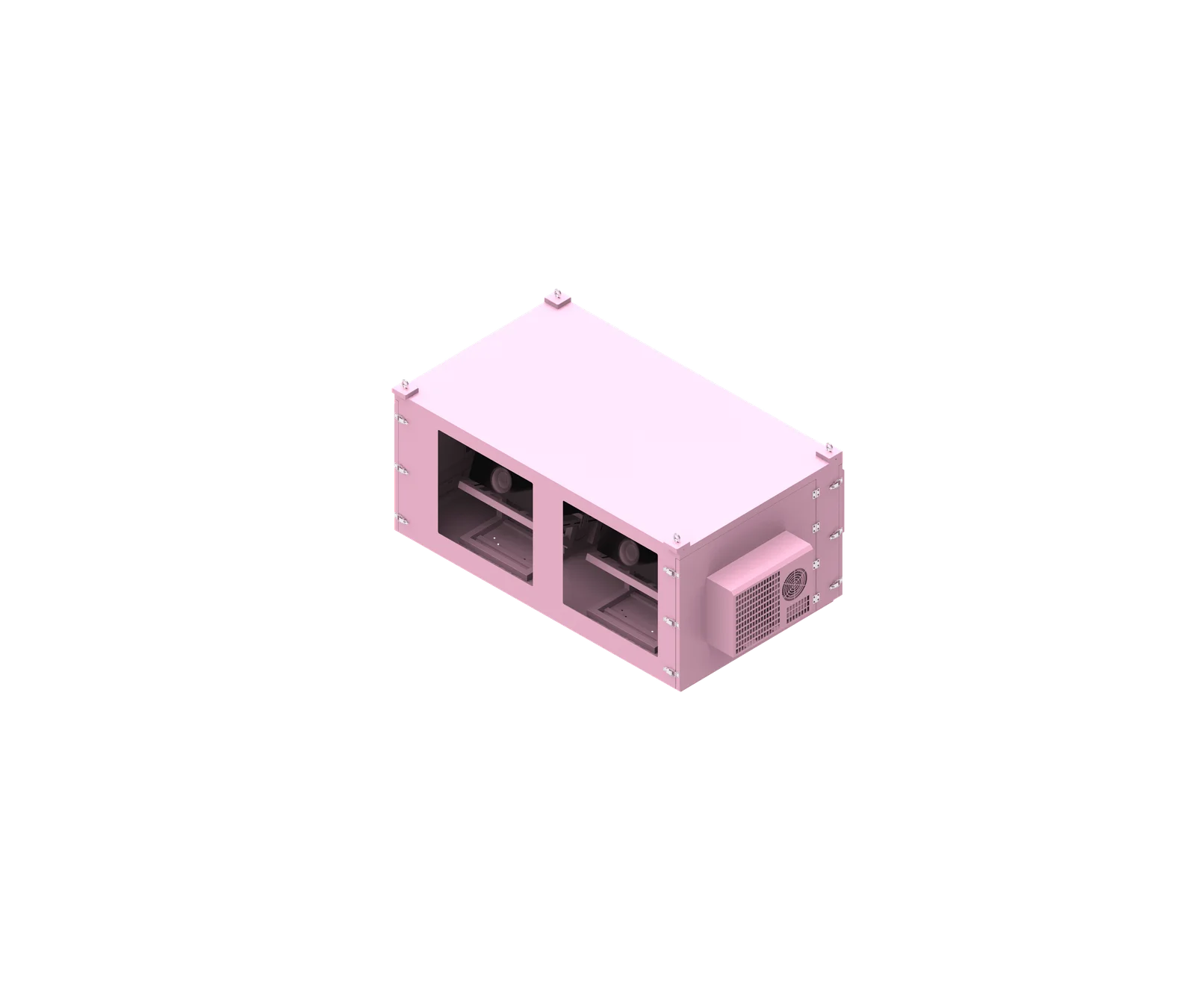
This engineering case study explains how ShiRui approached a custom outdoor projector enclosure for a scenic night tour application using two professional projectors, each rated at 15,000 lumens. The project required long-term outdoor installation, so the enclosure had to protect both units while coordinating airflow, optical windows, mounting, power distribution, cable routing, and maintenance access as one integrated engineering system.
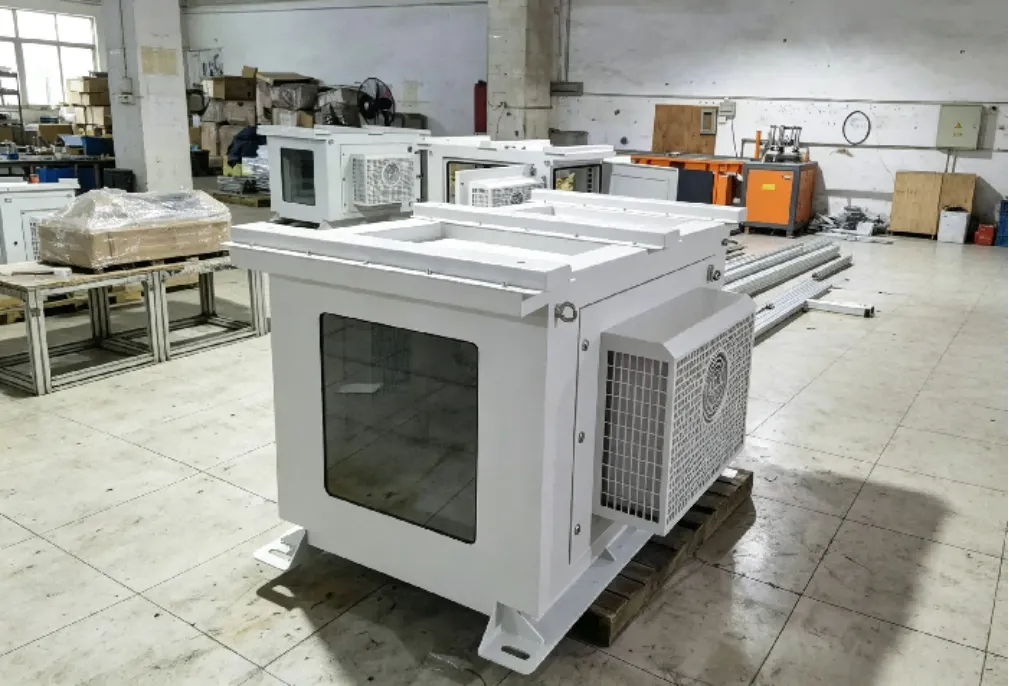
What is dual projector enclosure?
A dual projector enclosure is a protective outdoor cabinet designed to house two projectors in one engineered system. Unlike a single-projector cabinet, it must coordinate two heat sources, two optical paths, two mounting positions, and expanded electrical and maintenance requirements, especially for scenic night tour projection projects.
Engineering Definition
A dual projector enclosure is not simply a larger outdoor projector enclosure. When two 15,000-lumen projectors are installed together, the enclosure design changes across thermal management, airflow separation, structural support, optical geometry, and service planning.
For this ShiRui project, the verified application was an outdoor scenic night tour / cultural tourism projection project. The enclosure was designed to protect two professional projectors during long-term outdoor installation and operation.
Key design considerations include:
- Protection from outdoor conditions such as rain, dust, humidity, insects, and contaminants.
- Internal mounting for two professional projectors.
- Airflow planning for two independent heat sources.
- Optical-window design for two projection paths.
- Electrical distribution for both projectors and supporting systems.
- Maintenance access for lenses, cables, cooling components, and projector removal.
- Coordination with the actual projector models, lenses, and installation geometry.
A dual projector outdoor enclosure is especially relevant for cultural tourism night tours, building projection, landscape projection, heritage-site projection, outdoor immersive experiences, theme parks, and scenic-area performances.
ShiRui Pro Tip: I always start a dual-projector enclosure design by confirming the exact projector and lens models. Brightness tells us the projection class, but the cabinet must be engineered from physical size, airflow direction, power consumption, lens position, and service access.
How Does dual projector enclosure Work?
A dual projector enclosure works by combining outdoor protection, structured airflow, optical clearance, secure mounting, power distribution, and maintenance access inside one cabinet. For two 15,000-lumen projectors, the most important engineering task is preventing one projector’s hot exhaust from becoming the other projector’s intake air.
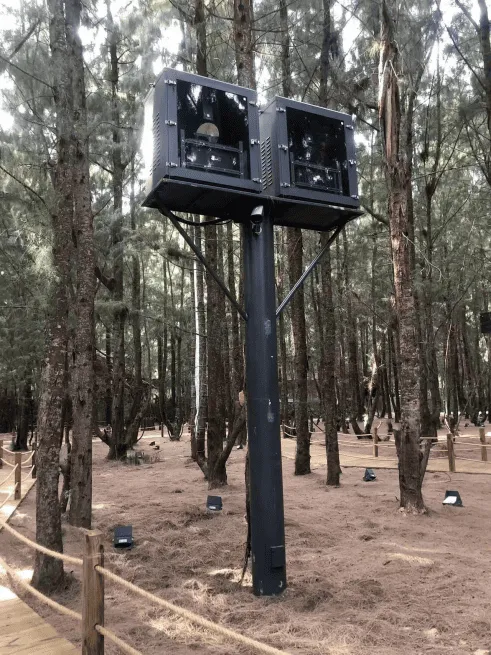
Operating Principle
The enclosure creates a controlled operating environment around two professional projectors that must remain installed outdoors. It protects the equipment while allowing each projector to project through a correctly positioned optical opening.
In a dual-projector configuration, the enclosure must manage several internal systems at the same time:
- Environmental protection
The cabinet protects the projectors from rain, dust, humidity, insects, and outdoor contaminants according to the project’s required protection level. - Thermal management
Cooling must be selected based on actual projector electrical and thermal data, not lumen output alone. - Airflow organization
Intake and exhaust paths must be arranged so hot air from one projector does not recirculate into the other projector. - Optical-window alignment
Window positions must follow the actual lens center, lens diameter, lens shift, projection angle, and required clear aperture. - Mechanical support
The mounting structure must support two projectors while maintaining accurate positioning. - Power and cable routing
The enclosure must accommodate more power, signal, network, and control cables than a single-projector cabinet. - Maintenance access
Technicians should be able to service one projector without unnecessarily disturbing the alignment of the other where practical.
This is why a custom projector enclosure for two projectors requires engineering coordination before sheet-metal fabrication begins.
ShiRui Pro Tip: In dual-projector designs, I do not approve the internal layout until the airflow map is reviewed. If exhaust and intake zones are not clearly separated, the enclosure may look correct mechanically but fail thermally during real operation.
How many lumens should an outdoor projector have for daylight?
Outdoor daylight projection usually requires very high brightness, but lumens alone do not define enclosure design. In this case, each projector was rated at 15,000 lumens. For engineering the enclosure, ShiRui focuses on actual projector power consumption, heat output, airflow direction, operating schedule, and site environment.
Lumens vs Enclosure Engineering
Lumens describe visible light output, not electrical power consumption or heat generation. A 15,000-lumen projector may have different thermal behavior depending on its light source, optical engine, cooling architecture, and manufacturer design.
For outdoor projection, brightness requirements depend on the viewing environment. Daylight projection is far more demanding than nighttime scenic projection. However, this case was a scenic night tour projection application, so the enclosure discussion should focus on long-term outdoor operation rather than using daylight brightness as the only design reference.
Based on our internal data and market analysis, here is the breakdown:
| Design Question | What Lumens Tell You | What Enclosure Engineers Still Need |
|---|---|---|
| Projection brightness | Approximate light output class | Actual projector model and lens |
| Heat calculation | Not enough information | Electrical power consumption and manufacturer thermal data |
| Cooling method | Not directly defined | Combined heat load, airflow direction, ambient conditions |
| Optical-window size | Only partially related | Lens diameter, lens shift, projection angle |
| Power design | Not reliable for sizing | Rated voltage, current, total load, accessories |
| Maintenance layout | No useful information | Projector size, weight, access direction, removal path |
For a 15000 lumen projector enclosure, the correct engineering process is to use brightness as project context, then design the enclosure from verified equipment data.
ShiRui Pro Tip: I never use lumens as a shortcut for heat-load calculation. Two projectors can share the same brightness rating but have different power draw, exhaust temperature, airflow direction, and cooling requirements.
What is the best outdoor enclosure for a projector?
The best outdoor enclosure for a projector is the one engineered around the exact projector, lens, site environment, installation method, and operating duty cycle. For dual 15,000-lumen projectors, the best solution is a custom outdoor projector enclosure, not a generic oversized cabinet.
Selection Criteria
For scenic night tour projection, the enclosure must protect equipment outdoors while maintaining stable projection performance. The best design depends on the actual project conditions rather than a universal cabinet specification.
A reliable outdoor projector enclosure should evaluate:
- Exact projector model and quantity.
- Projector dimensions and weight.
- Power consumption and heat output.
- Air intake and exhaust positions.
- Lens model, lens center, and lens shift requirements.
- Projection distance and projection angle.
- Site temperature range, humidity, rain exposure, dust, and solar exposure.
- Installation method, such as platform, pole, frame, or project-specific support.
- Maintenance access for both projectors and supporting systems.
- Cable routing for power, signal, network, and control lines.
For a dual projector enclosure, the “best” design must solve problems that do not exist in the same way for a single projector: two heat sources, two optical paths, two mounting positions, expanded wiring, and more complex service access.
Cooling method selection should consider combined projector heat load, ambient temperature, enclosure size, solar exposure, operating duration, and environmental conditions. Depending on the project, engineered forced-air cooling or air-conditioned thermal management may be appropriate, but the method should not be assumed without project data.
ShiRui Pro Tip: I recommend choosing the enclosure after the projector and lens package is confirmed. If the cabinet is selected first, the optical window, airflow path, and service access may all require compromise later.
Where can I find a waterproof case for my projector?
You can source a waterproof projector case from a professional enclosure manufacturer such as ShiRui when the project requires outdoor protection, thermal management, optical alignment, and long-term installation. For professional scenic night tour projection, a custom outdoor projector enclosure is usually more appropriate than a simple storage case.
Procurement Guidance
A waterproof case and an outdoor projector enclosure are not always the same product. A storage case may protect equipment during transport, but a long-term outdoor projector enclosure must allow the projector to operate while protected.
For a dual-projector scenic night tour project, buyers should provide detailed technical information before fabrication:
- Projector brand and exact model.
- Quantity of projectors.
- Brightness of each projector.
- Projector dimensions and weight.
- Power consumption.
- Air intake and exhaust positions.
- Lens model and lens geometry.
- Lens shift requirements.
- Projection distance and angle.
- Installation method.
- Site temperature range.
- Humidity and environmental conditions.
- Operating hours or expected duty cycle.
- Power supply requirements.
- Required protection level, such as the appropriate IP Code rating.
- Site drawings or photos.
- Maintenance access expectations.
With this information, ShiRui can evaluate whether the enclosure should use separate optical windows or a larger shared optical opening, how the projectors should be arranged, and how the internal airflow and cable routes should be planned.
ShiRui Pro Tip: When customers ask for a “waterproof case,” I first clarify whether the projector must operate inside the cabinet. If it will run outdoors, we need an engineered enclosure with cooling, optics, sealing, wiring, and service access—not just a sealed box.
Key Features & Comparison
The key difference between a single-projector enclosure and a dual projector enclosure is system complexity. Two 15,000-lumen projectors change heat management, airflow paths, lens positions, optical-window design, power distribution, cable routing, mounting structure, and maintenance planning, even when both projectors appear similar externally.
Single vs Dual 15,000-Lumen Projector Enclosure
Based on our internal data and market analysis, here is the breakdown:
| Design Area | Single Projector | Dual Projector |
|---|---|---|
| Heat Sources | One | Two |
| Airflow | Simpler | Must coordinate both projectors |
| Lens Positions | One | Two |
| Optical Design | Single light path | Dual light paths |
| Power | One projector load | Two projector loads |
| Cable Routing | Simpler | More power/signal cables |
| Mounting | Single support | Dual support/alignment |
| Maintenance | One removal path | Independent access preferred |
For this projector enclosure case study, the most important lesson is that dual-projector design must begin with system mapping. The enclosure layout should not be based only on fitting two projector bodies into one cabinet.
Additional feature considerations include:
- Thermal separation: Reduce the risk of hot-air recirculation between projectors.
- Independent airflow planning: Maintain organized intake and exhaust paths where appropriate.
- Optical accuracy: Position windows according to actual lens centers and projection geometry.
- Structural rigidity: Support two professional projectors and maintain alignment.
- Service access: Allow technicians to reach lenses, cables, filters or service points, cooling components, and electrical systems.
- Electrical planning: Account for both projectors and enclosure systems before fabrication.
- Condensation awareness: Evaluate humidity and temperature changes, especially for nighttime operation, because condensation can affect optical clarity and internal electronics.
ShiRui Pro Tip: The comparison table is where many project risks become visible. If a design only scales up cabinet size but does not change airflow, power layout, optical-window planning, and maintenance access, it is not a true dual-projector enclosure design.
Cost & Buying Factors
The cost of a dual projector enclosure depends on projector size, quantity, cooling method, environmental protection requirements, optical-window design, mounting structure, electrical configuration, fabrication complexity, and maintenance access. For two 15,000-lumen projectors, pricing should be based on engineering scope rather than cabinet volume alone.
Pricing Drivers
A custom outdoor projector enclosure is priced according to design requirements and manufacturing complexity. Since this project used two professional 15,000-lumen projectors, cost evaluation must consider the complete operating system inside the enclosure.
Based on our internal data and market analysis, here is the breakdown:
| Buying Factor | Why It Affects Cost |
|---|---|
| Projector model and dimensions | Determines enclosure layout, mounting structure, and service space |
| Projector weight | Influences internal support and structural design |
| Quantity of projectors | Adds heat sources, wiring, optical paths, and mounting requirements |
| Cooling method | Forced-air or temperature-controlled systems require different components |
| Optical-window design | Separate or shared openings affect fabrication and alignment requirements |
| Environmental protection level | Sealing, doors, gaskets, cable entry, and contamination control affect design |
| Cable and power layout | Two projectors require more organized electrical routing |
| Maintenance access | Multiple access points or special removal paths may increase complexity |
| Installation interface | Site-specific mounting support can affect structure and fabrication |
| Pre-production confirmation | Engineering drawings and review reduce fabrication risk |
The buyer should avoid comparing a dual projector outdoor enclosure only by external size. A lower-cost cabinet that does not manage airflow, condensation risk, optical clearance, or service access can create operational problems after installation.
A practical buying workflow is:
- Confirm project requirements.
- Confirm the two projector models.
- Confirm lens models.
- Evaluate projector dimensions and weights.
- Review power consumption and thermal data.
- Map intake and exhaust airflow.
- Determine projector arrangement.
- Design mounting structure.
- Determine optical-window positions.
- Select the thermal-management method.
- Plan power distribution and cable routing.
- Confirm maintenance access.
- Review technical drawings before fabrication.
- Proceed to manufacturing, assembly, and functional inspection.
ShiRui Pro Tip: For budgeting, I advise customers to treat engineering confirmation as part of the purchase, not an optional step. The cost of redesigning after fabrication is usually higher than confirming projector, lens, airflow, and installation data at the beginning.
Conclusion
A reliable dual projector enclosure for scenic night tour projection must be engineered around the exact projectors, lenses, site conditions, and installation geometry. Two 15,000-lumen projectors change the thermal load, airflow, optical layout, mounting structure, electrical system, cable routing, and maintenance strategy.
Engineering Takeaways
This ShiRui case demonstrates that a dual-projector outdoor enclosure is a coordinated technical system. It must protect two professional projectors while supporting stable projection, safe operation, and practical maintenance in an outdoor scenic night tour environment.
Key lessons include:
- A dual-projector enclosure is not simply a larger single-projector cabinet.
- Each 15,000-lumen rating refers to one projector, not the combined brightness.
- Lumens should not be used as the heat-load calculation.
- Cooling should be based on actual projector power and manufacturer thermal data.
- One projector’s exhaust should not become the other projector’s intake air.
- Airflow paths should be organized around the actual projector models.
- Optical-window positions should follow lens geometry, lens shift, and projection angle.
- Mounting design should support two projectors securely and maintain alignment.
- Maintenance access should be planned before fabrication.
- Power distribution and cable routing must account for two projectors and enclosure systems.
For similar scenic night tour projection projects, ShiRui recommends preparing projector specifications, lens data, site drawings, environmental conditions, operating requirements, and installation details before enclosure design begins.
ShiRui Pro Tip: If you are planning a dual 15,000-lumen outdoor projection system, send the projector model, lens model, airflow drawings, site conditions, and installation concept first. With that information, we can design the enclosure as a complete protection, cooling, optical, and maintenance system.