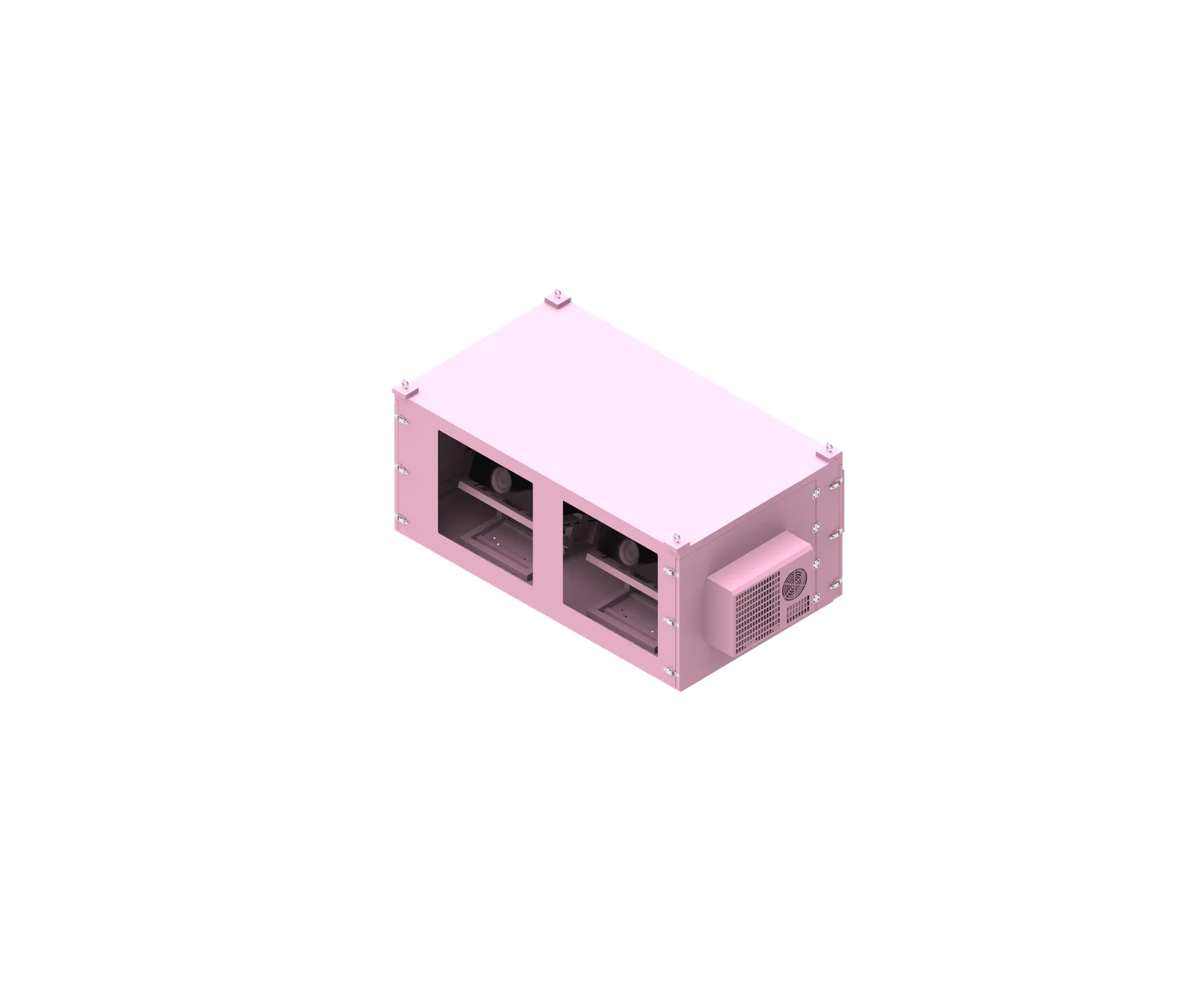
Selecting the right cooling method for an outdoor projector enclosure is an engineering decision, not a simple choice between “fan” and “AC.” The correct solution depends on projector heat output, enclosure size, airflow path, ambient temperature, humidity, dust, salt spray, operating hours, and sealing requirements. ShiRui evaluates these conditions together to determine whether fan cooling, air conditioning, hybrid cooling, or sealed internal circulation is appropriate.
What is outdoor projector enclosure?
An outdoor projector enclosure is a protective housing designed to allow a projector to operate safely in outdoor or harsh environments. It helps protect against rain, dust, insects, corrosion, temperature changes, humidity, and unauthorized contact while supporting proper airflow, cooling, heating, dehumidification, and optical projection through a high-transmittance glass window.
Protective Function and Engineering Purpose
An outdoor projector enclosure is not only a metal box around a projector. It must protect the projector while still allowing the projector to breathe, cool, project clearly, and operate reliably. For this reason, ShiRui outdoor projector enclosure solutions are commonly customized according to projector model, dimensions, heat output, installation method, environmental exposure, and maintenance conditions.
ShiRui enclosure materials may include 201 stainless steel, 304 stainless steel, galvanized plate, or other customized materials depending on the project. Common configurations include fresh-air ventilation, fresh-air plus air conditioning, internal-circulation air conditioning, and remote-control versions using WiFi, Ethernet, 4G, or IoT platform connectivity.
Key enclosure functions may include:
- Waterproof and dustproof protection, with designs available up to IP65 depending on project requirements
- Anti-corrosion structure for demanding outdoor sites
- F6 medium-efficiency filtration to reduce dust and insect ingress in ventilated systems
- Built-in temperature probe and temperature-humidity sensor
- Heating and dehumidification functions
- Reserved 10A or 16A multifunctional socket
- Smoke alarm, flooding alarm, and road-temperature sensing options
- Internal air-blowing device to help reduce fog or frost on the projection window
- Optical ultra-white glass projection port with high light transmittance
ShiRui Pro Tip: I always recommend treating the enclosure and projector as one thermal system. A strong enclosure with poor airflow can still damage projector performance, while a properly engineered enclosure protects the projector and supports stable operation.
How Does outdoor projector enclosure Work?
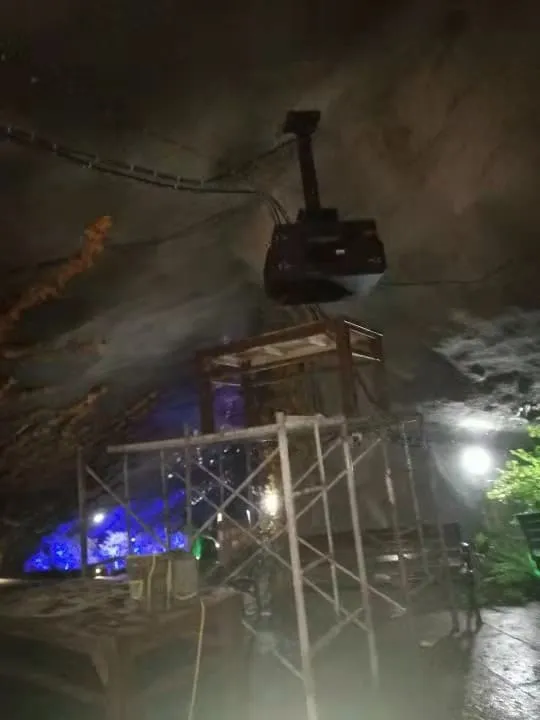
An outdoor projector enclosure works by combining physical protection, thermal control, humidity management, air filtration, and optical transmission. Depending on site conditions, it may use filtered outside-air ventilation, active air conditioning, hybrid cooling, or sealed internal circulation to manage projector heat while reducing exposure to rain, dust, insects, salt air, and humidity.
Thermal Control and Environmental Protection Process
A properly designed outdoor projector enclosure must manage two different challenges at the same time: external environmental protection and internal heat removal. The projector produces heat during operation, and that heat must be removed or controlled without exposing the equipment to damaging outdoor conditions.
A typical engineering workflow includes:
- Projector heat assessment ShiRui reviews the projector brand, model, specification sheet, power consumption, dimensions, air intake location, and exhaust location.
- Site condition review Maximum and minimum ambient temperature, humidity, dust, sand, insects, salt spray, and installation method are evaluated.
- Cooling method selection The enclosure may use fan cooling, air conditioning, hybrid cooling, or sealed internal-circulation air conditioning depending on heat load and environmental risk.
- Airflow path design Internal airflow space must be maintained so hot air does not recirculate directly into the projector intake.
- Humidity and condensation control Cooling alone does not prevent condensation. Heating, dehumidification, and humidity monitoring may be required.
- Control system setup Some ShiRui systems may use example settings such as cooling around 35°C or heating around 5°C, but these are project-specific examples, not universal specifications.
ShiRui Pro Tip: I never choose the cooling system before confirming the projector’s intake and exhaust positions. If the enclosure airflow fights against the projector’s own airflow design, even a powerful cooling device may not solve the heat problem.
Are cooling fans better than air conditioners?
Cooling fans are not universally better than air conditioners, and air conditioners are not automatically superior to fans. Fan cooling is often suitable for moderate heat loads and cleaner environments, while air conditioning should be considered when ambient temperature, heat output, operating time, or temperature stability requirements exceed what ventilation can handle.
Fan Cooling Versus Active Cooling
Fan cooling uses controlled outside-air exchange to remove internal heat from the outdoor projector enclosure. It is generally considered when the projector heat load is moderate, the surrounding air temperature allows ventilation cooling, the outdoor air is relatively clean, and filter maintenance is acceptable.
Air conditioning provides active cooling when outside-air ventilation is not enough. It may be considered for high heat output projectors, hotter environments, long operating hours, or projects requiring more stable internal temperature control.
Based on our internal data and market analysis, here is the breakdown:
| Factor | Fan Cooling | Air Conditioning |
|---|---|---|
| Cooling principle | Moves outside air through the enclosure | Uses active refrigeration to remove heat |
| Best suited for | Moderate heat load and cleaner air | Higher heat load or hotter sites |
| Sealing level | Usually requires air intake and exhaust | Can support more controlled or sealed designs |
| Maintenance | Filter and fan maintenance | AC unit, drainage, condenser, and system maintenance |
| Space requirement | Usually simpler and more compact | Requires more internal space and installation planning |
| Main risk | Dust, insects, hot intake air, filter blockage | Condensation, power demand, AC maintenance |
Neither method should be selected based on projector lumens alone. Two projectors with similar brightness can have different power consumption, heat generation, airflow direction, and cooling requirements.
ShiRui Pro Tip: I describe fan cooling and air conditioning as different tools, not different quality levels. The better choice is the one that matches the projector’s heat load and the site’s environmental conditions.
What is the $5000 rule for AC?
The “$5000 rule” is a common HVAC replacement guideline for buildings: multiply repair cost by equipment age, and if the result exceeds 5000, replacement may be considered. For an outdoor projector enclosure, it should not be used as a technical cooling-selection rule because projector protection requires project-specific thermal evaluation.
Why Building HVAC Rules Do Not Directly Apply
The $5000 rule is commonly discussed for residential or commercial air conditioners. It is useful for deciding whether to repair or replace an aging HVAC unit, but it does not determine whether an outdoor projector enclosure needs fan cooling, air conditioning, hybrid cooling, or internal-circulation cooling.
For projector enclosures, the decision depends on engineering factors such as heat load, enclosure size, airflow path, ambient temperature, humidity, dust exposure, salt spray, sealing requirements, and operating hours.
A more relevant evaluation process is:
- Confirm projector power consumption Power consumption is often more useful than brightness for estimating heat load.
- Check projector airflow design Intake and exhaust locations affect internal ducting and fan placement.
- Review maximum ambient temperature Fan cooling becomes less effective when outside air is already too hot for the required internal conditions.
- Assess humidity and condensation risk AC may cool the air, but condensation can still occur if dew-point conditions are not controlled.
- Evaluate maintenance access Filters, fans, drainage, and AC components require service planning.
- Select the enclosure structure Ventilated, air-conditioned, hybrid, or sealed internal-circulation designs should be chosen according to the full project profile.
ShiRui Pro Tip: I would not use a household AC cost rule to size or select cooling for a projector enclosure. The correct method is to evaluate the projector, enclosure, and site as one operating system.
How many fans is equal to 1 AC?
There is no reliable number of fans that equals one air conditioner in an outdoor projector enclosure. Fans exchange air; air conditioners actively remove heat. Their performance depends on airflow volume, air temperature, projector heat output, enclosure design, filtration resistance, humidity, and whether outside air is suitable for cooling.
Why Fan Quantity Cannot Replace Cooling Engineering
Adding more fans does not automatically create the same effect as an air conditioner. Fans can only move air. If the outside air is hot, dusty, humid, salty, or contaminated, simply increasing fan quantity may introduce new risks while failing to maintain suitable internal conditions.
Air conditioning changes the thermal condition of the air through active cooling. In sealed internal-circulation designs, the system may reduce direct outside-air exchange while using the AC compressor to cool the internal air. This is especially useful where outside-air intake is undesirable.
Important differences include:
- Fans depend on outside air quality and temperature If outside air is too hot or contaminated, ventilation may not be suitable.
- Air conditioners actively remove heat They can support more controlled internal conditions when ventilation is insufficient.
- More fans can increase dust and moisture exposure Without proper filtration and maintenance, ventilation can carry dust, insects, salt spray, or humidity into the enclosure.
- Airflow path matters more than fan count Poor placement can cause hot-air recirculation or dead zones.
- Condensation still requires separate control AC cooling does not automatically prevent water condensation inside the enclosure.
ShiRui Pro Tip: I do not convert fans into “AC equivalents.” Instead, I calculate the project conditions and decide whether ventilation can remove the heat safely, or whether active cooling is required.
Why Lumens Alone Cannot Determine the Cooling Method
Projector brightness alone cannot determine the cooling method because lumens do not directly show power consumption, heat generation, airflow design, operating duration, or environmental exposure. Two projectors with similar lumen ratings may require different outdoor projector enclosure cooling systems because their electrical load and thermal behavior can be very different.
Brightness Is Not the Same as Heat Load
It is a common mistake to choose fan cooling or air conditioning only according to projector lumens. Lumens describe brightness output, not the full thermal behavior of the projector. A projector with efficient light technology may produce high brightness with lower heat, while another projector with similar lumens may consume more power and generate more heat.
ShiRui therefore reviews the projector specification sheet and operating environment before recommending the enclosure cooling structure.
Based on our internal data and market analysis, here is the breakdown:
| Selection Factor | Why It Matters More Than Lumens |
|---|---|
| Projector power consumption | Indicates likely heat generation more directly than brightness |
| Projector brand and model | Different models use different thermal designs |
| Air intake and exhaust positions | Determines enclosure airflow layout |
| Projector dimensions | Affects internal air space and heat accumulation |
| Daily operating hours | Longer use increases thermal stress |
| Maximum ambient temperature | Determines whether outside-air cooling is practical |
| Humidity and dew point | Affects condensation risk |
| Dust, sand, insects, salt spray | Determines whether ventilation is acceptable |
| Maintenance access | Affects filter and AC service feasibility |
This is why ShiRui does not recommend selecting cooling based on a fixed lumen level. The correct approach is project-specific thermal evaluation.
ShiRui Pro Tip: When a customer gives me only the lumen rating, I consider the information incomplete. I need the projector model, power consumption, airflow direction, and site temperature before making a responsible recommendation.
When Fan Cooling Is Usually the Better Choice
Fan cooling is usually the better engineering choice when the projector heat load is moderate, outside air is suitable for heat removal, the environment is relatively clean, filter maintenance is practical, and a fully sealed structure is not required. It provides controlled ventilation with lower system complexity than active air conditioning.
Suitable Conditions for Ventilated Cooling
Fan-cooled outdoor projector enclosure designs use controlled airflow to remove heat from the enclosure. ShiRui may combine ventilation with F6 medium-efficiency air filtration to reduce airborne dust and insect ingress while maintaining airflow.
Fan cooling should not be described as only suitable below a fixed lumen level. The real decision depends on projector power consumption, heat output, ambient temperature, air quality, and operating time.
Fan cooling is usually considered when:
- The projector heat load is moderate
- The maximum ambient temperature allows outside-air cooling
- The site has relatively clean air
- Dust and insects can be managed with filtration
- Filter maintenance is acceptable
- The enclosure does not need to be fully sealed
- The projector airflow path can be matched with enclosure intake and exhaust design
- Energy use and system complexity need to be controlled without sacrificing thermal safety
However, fan cooling requires maintenance. Filters can become blocked, and blocked filters reduce airflow. If the enclosure is installed in a dusty, sandy, coastal, or polluted environment, a ventilated design may introduce risk.
ShiRui Pro Tip: I recommend fan cooling when the environment supports it, not because it is “simpler.” A well-designed fan-cooled enclosure can be the correct professional solution when airflow, filtration, and maintenance are properly planned.
When Air Conditioning Should Be Considered
Air conditioning should be considered when ventilation alone cannot maintain suitable internal conditions. This may happen with high projector heat output, high ambient temperature, long daily operating hours, limited clean outside air, or projects requiring more stable internal temperature control inside the outdoor projector enclosure.
Conditions That Require Active Cooling
Air conditioning provides active cooling instead of relying only on outside-air exchange. This makes it useful when the surrounding air is too hot, when the projector generates significant heat, or when the enclosure requires tighter thermal control.
The air-conditioning configuration should be selected according to projector power consumption, enclosure size, ambient temperature, airflow design, humidity, and operating conditions. It should not be selected by assuming a universal cooling capacity or guaranteed internal temperature.
Air conditioning may be considered when:
- Projector heat output is high Higher electrical power often means higher heat load.
- Ambient temperature is high If outside air is too warm, fan cooling may not provide enough heat removal.
- Operating hours are long Continuous or extended operation increases thermal accumulation.
- Temperature stability is important Some applications require more controlled internal conditions.
- Ventilation is environmentally risky Dust, sand, humidity, pollution, or salt air may make outside-air intake undesirable.
- The enclosure has limited ventilation options Installation method or sealing requirements may restrict airflow.
Air conditioning also requires space, power, maintenance access, and condensation management. Drainage, humidity monitoring, and dehumidification must be considered.
ShiRui Pro Tip: I consider air conditioning when the project conditions demand active cooling, not as a premium upgrade. If the site is hot, humid, dusty, or heavily loaded thermally, AC may be the practical engineering answer.
When a Fully Sealed Internal-Circulation System Is More Suitable
A fully sealed internal-circulation air-conditioned enclosure is more suitable when outside-air exchange is undesirable, such as sandy, dusty, coastal, high-humidity, underground, subway, or polluted environments. It minimizes direct exposure to external contaminants while using active cooling to manage internal heat.
Sealed Cooling for Harsh Environments
A fully sealed internal-circulation system uses active cooling while minimizing direct exchange with outside air. In this structure, the enclosure may be equipped with an air conditioner and no conventional fan outlet or dedicated outside-air intake. The internal air circulates through the air-conditioning system to remove heat.
This configuration may be suitable for:
- Desert and sandy environments
- Coastal and salt-air environments
- High-humidity locations
- Subway or underground projects
- Dusty or polluted industrial areas
- Installations where outside-air intake is undesirable
- Projects where dust, sand, salt spray, or external humidity must be reduced
This structure helps reduce direct exposure to outdoor contaminants, but it does not eliminate all environmental risks. Internal humidity and condensation still need to be monitored and controlled. Cooling alone does not prevent condensation.
ShiRui sealed or internal-circulation designs may include temperature and humidity sensing, heating, dehumidification, alarm functions, and remote monitoring depending on project requirements.
ShiRui Pro Tip: I recommend sealed internal circulation when the outside air is the problem. But I still plan humidity control carefully, because sealing the enclosure does not automatically remove moisture already inside the system.
Key Features & Comparison
The main cooling options for an outdoor projector enclosure are fan cooling, air conditioning, hybrid cooling, and fully sealed internal circulation. Each method has different requirements for outside-air exchange, maintenance, sealing, power, and environmental suitability, so the best choice must be confirmed according to the actual projector and site conditions.
Cooling Method Comparison
Based on our internal data and market analysis, here is the breakdown:
| Cooling Method | Outside-Air Exchange | Typical Environment | Main Advantage | Main Limitation | Maintenance Requirement |
|---|---|---|---|---|---|
| Fan Cooling | Yes, through controlled intake and exhaust | Moderate heat load, relatively clean outdoor air | Lower system complexity and effective ventilation when conditions allow | Depends on outside-air temperature and cleanliness | Filter cleaning or replacement, fan inspection |
| Air Conditioning | Limited or controlled, depending on design | Higher heat load, hotter sites, longer operating hours | Provides active cooling when ventilation is insufficient | Requires more space, power, and AC maintenance | AC service, drainage check, sensor inspection |
| Hybrid Cooling | Yes, with active cooling added when needed | Sites with variable temperature or staged cooling needs | Balances ventilation and active cooling according to conditions | More components and control logic | Filter, fan, AC, and controller maintenance |
| Fully Sealed Internal Circulation | Minimal direct outside-air exchange | Dusty, sandy, coastal, humid, subway, underground, or polluted sites | Reduces direct exposure to dust, sand, salt air, and outside humidity | Requires active cooling and humidity management | AC service, humidity control, sensor and seal inspection |
ShiRui outdoor projector enclosure products may be customized with fresh-air systems, fresh-air plus air conditioning, internal-circulation air conditioning, remote control versions, temperature probes, humidity sensors, alarms, waterproofing, dustproofing, anti-corrosion design, heating, and dehumidification.
ShiRui Pro Tip: I use comparison tables only as a starting point. The final decision still depends on the projector specification sheet, site temperature, humidity, contaminants, installation method, and maintenance plan.
Cost & Buying Factors
The cost of an outdoor projector enclosure depends on material, dimensions, cooling method, sealing level, control system, filtration, sensors, alarms, remote monitoring, heating, dehumidification, and customization requirements. Buyers should compare total engineering suitability, not only enclosure price, because poor cooling selection can increase maintenance risk and projector failure risk.
Practical Buying Checklist
Pricing varies because ShiRui outdoor projector enclosures are often non-standard customized products. A small ventilated enclosure and a fully sealed internal-circulation air-conditioned enclosure have different material, control, assembly, testing, and maintenance requirements.
Important buying factors include:
- Projector brand and model Determines dimensions, heat output, airflow path, and installation clearance.
- Projector power consumption Helps evaluate heat load more accurately than lumens alone.
- Projector dimensions Affects enclosure size, airflow space, and service access.
- Maximum and minimum ambient temperature Determines cooling, heating, and protection requirements.
- Humidity conditions Affects condensation risk and dehumidification needs.
- Dust, sand, insects, or salt spray Determines whether filtered ventilation or sealed internal circulation is more suitable.
- Daily operating hours Longer use may require stronger thermal management and maintenance planning.
- Installation method Wall mount, pole mount, platform, truss, or custom installation affects structure and airflow.
- Material selection 201 stainless steel, 304 stainless steel, galvanized plate, or other materials may be selected according to the environment and customer requirements.
- Control and monitoring needs WiFi, Ethernet, 4G, IoT platform connection, data encryption, alarms, and remote control can be added according to project needs.
Common mistakes to avoid:
- Choosing cooling only by projector lumens
- Ignoring power consumption
- Ignoring maximum ambient temperature
- Ignoring humidity and condensation
- Using outside-air ventilation in dusty or coastal environments
- Leaving insufficient internal airflow space
- Ignoring filter maintenance
- Assuming IP65 sealing solves heat and humidity problems
ShiRui Pro Tip: I advise customers to budget for the correct cooling structure, not just the box. The enclosure material protects the projector from weather, but the thermal and humidity system protects it during real operation.
Condensation Must Be Managed Separately from Cooling
Condensation is a separate engineering issue from cooling. Even an air-conditioned or sealed outdoor projector enclosure can develop condensation if humidity and dew-point conditions are not controlled. Heating, dehumidification, airflow management, humidity monitoring, and correct control logic may be required to reduce condensation risk.
Why Cooling Alone Is Not Enough
Cooling reduces temperature, but condensation depends on humidity and dew point. If warm humid air contacts a cooler surface inside the enclosure, water may condense on the projector, glass, wiring, electronics, or internal metal surfaces.
This can happen in ventilated enclosures, air-conditioned enclosures, and sealed internal-circulation enclosures. A sealed box can still contain moisture from installation, cable openings, service access, or trapped internal air.
Condensation control may involve:
- Temperature and humidity sensing Built-in sensors help monitor real internal conditions.
- Heating control Some ShiRui systems may use example heating logic around 5°C or humidity-based activation, but settings must be confirmed for each project.
- Dehumidification Dehumidification helps control moisture instead of only changing temperature.
- Internal air circulation Air movement can reduce cold spots and fogging near the projection window.
- Projection-window anti-fog airflow Internal blowing devices may help reduce frost or fog on the glass surface.
- Sealing and cable-entry design Poor cable sealing can allow humid air or water vapor to enter.
- Monitoring and alarms Temperature, humidity, smoke, flooding, and other sensors can support safer operation.
IP65 protection can help resist water and dust ingress, but it does not automatically solve internal heat buildup or condensation. Thermal design and humidity control must still be engineered.
ShiRui Pro Tip: I always check humidity separately from temperature. A system that looks cool enough can still be unsafe if dew-point conditions allow condensation inside the enclosure.
Conclusion
The correct choice between fan cooling and air conditioning depends on the projector, enclosure design, and installation environment. Fan cooling, air conditioning, hybrid cooling, and fully sealed internal circulation are all valid engineering solutions when applied correctly. The final selection should be confirmed through project-specific thermal and environmental evaluation.
Final Recommendation and Next Step
ShiRui does not recommend choosing an outdoor projector enclosure cooling method based on projector lumens alone. Brightness does not fully represent heat output, airflow design, or operating risk. Power consumption, ambient temperature, humidity, contamination, sealing, and maintenance access are more important for selecting the correct thermal structure.
For accurate evaluation, customers should provide:
- Projector brand and model
- Projector specification sheet
- Power consumption
- Projector dimensions
- Quantity
- Maximum and minimum ambient temperature
- Humidity conditions
- Daily operating hours
- Dust, sand, insects, pollution, or salt-spray conditions
- Installation method
- Site photos or installation drawings
With this information, ShiRui can evaluate whether fan cooling, air conditioning, hybrid cooling, or fully sealed internal-circulation air conditioning is more suitable for the project. The final cooling method should always be confirmed through project-specific thermal evaluation rather than a universal rule.
ShiRui Pro Tip: Send us the projector specification sheet and site conditions before ordering. I can help review the heat load, airflow path, humidity risk, and enclosure structure so the cooling method matches the real project environment.