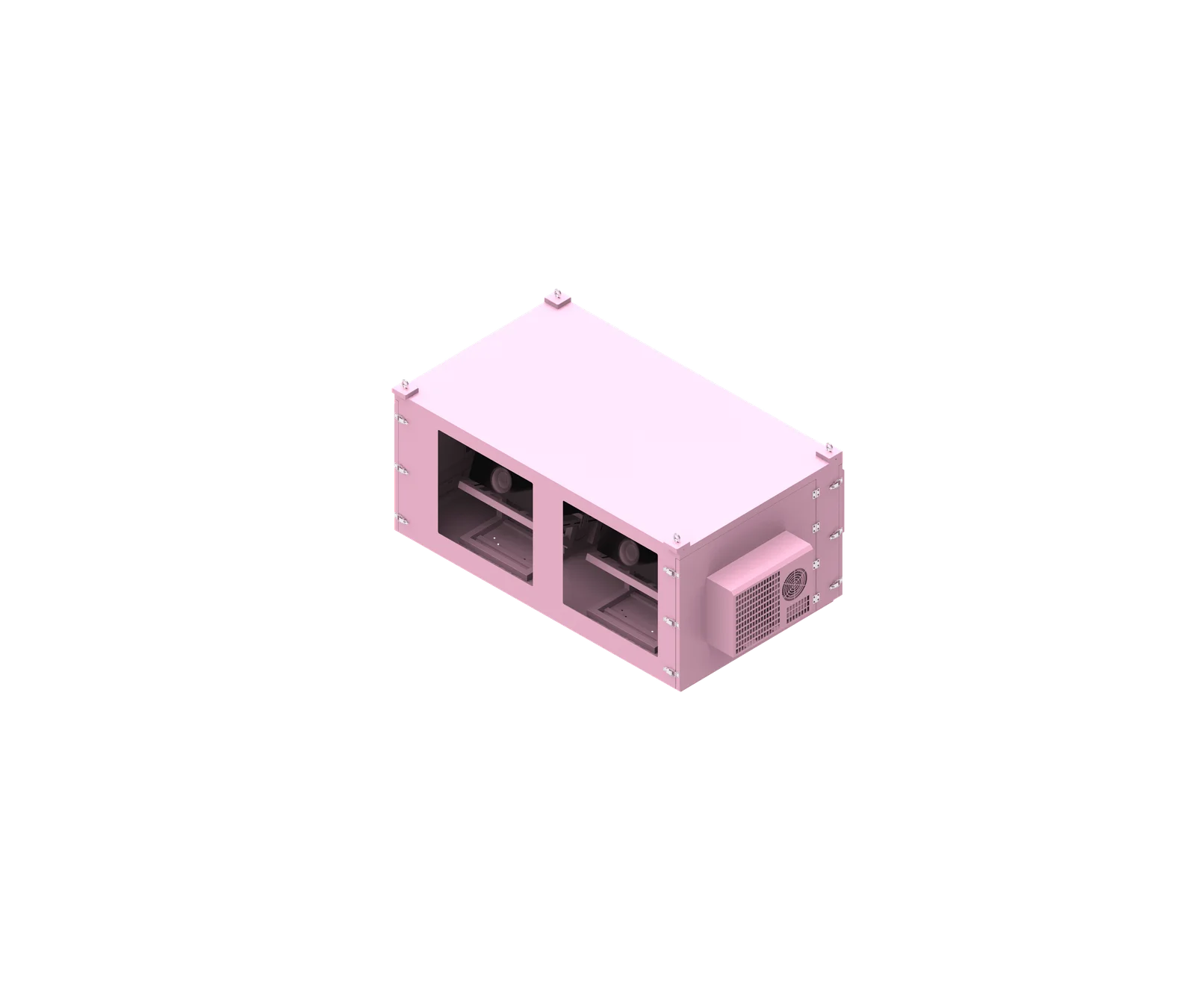
Outdoor network cabinet cooling is the engineering process of controlling heat inside an outdoor network cabinet so switches, routers, power supplies, UPS equipment, and communication electronics can operate reliably. The correct choice between natural ventilation, outdoor network cabinet fan cooling, and an outdoor cabinet air conditioner depends on heat load, ambient temperature, solar exposure, dust, humidity, IP protection, and operating conditions.
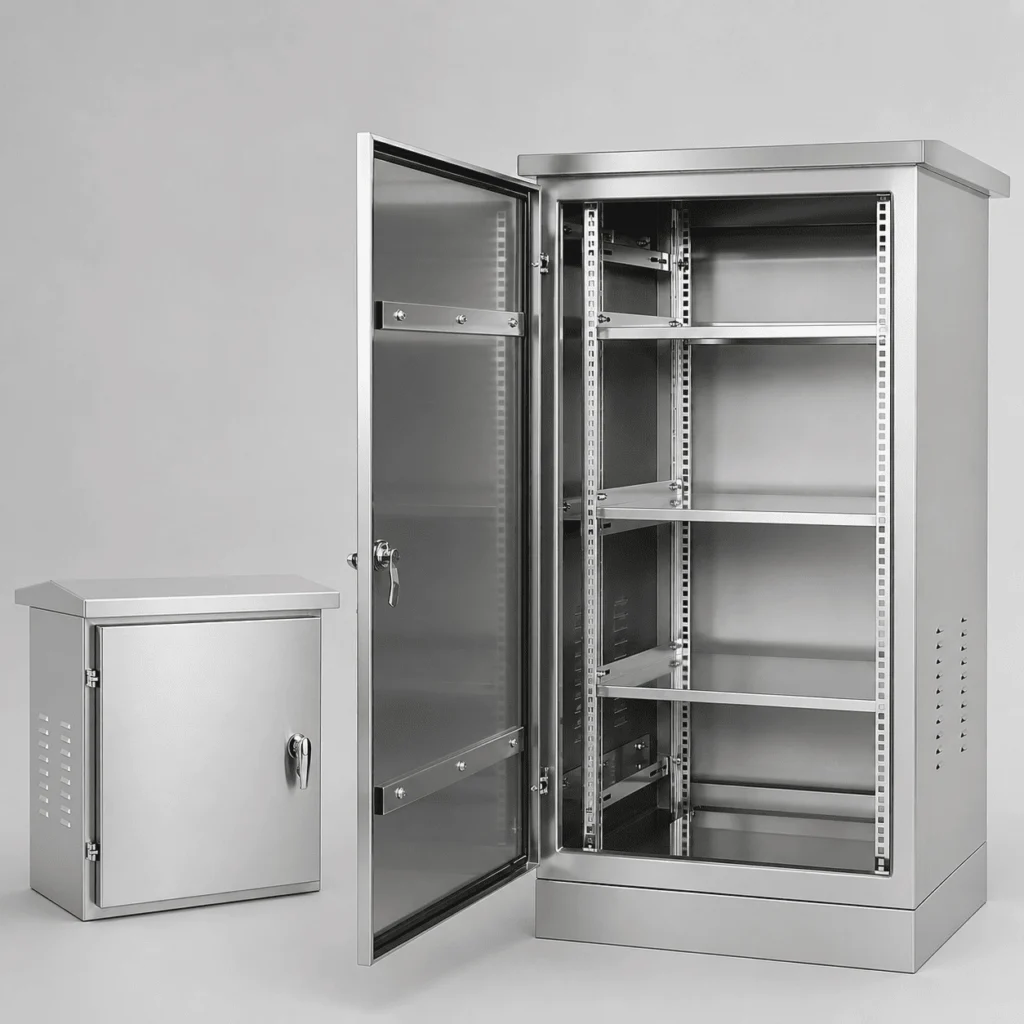
What is outdoor network cabinet cooling?
Outdoor network cabinet cooling is the design of airflow, heat removal, and temperature control for electronics installed in an outdoor network cabinet. It may use natural ventilation, fan cooling, industrial air conditioning, or other thermal systems, but the selection must be based on equipment heat load and site conditions—not cabinet size alone.
Thermal Management Purpose
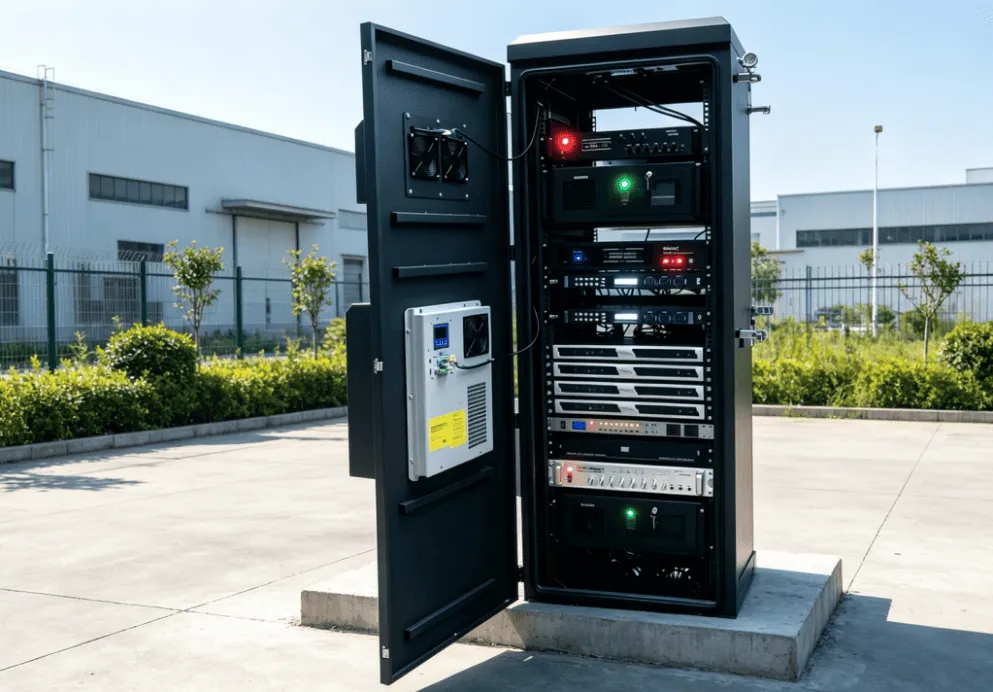
Outdoor network cabinet cooling protects active electronics from heat accumulation inside a sealed or semi-sealed enclosure. As a professional outdoor network cabinet and custom sheet-metal enclosure manufacturer, ShiRui treats cooling as part of the complete cabinet design, not as an accessory selected at the end.
Heat can come from installed equipment, solar exposure, power conversion losses, UPS systems, and heat transmitted through cabinet surfaces. Environmental factors such as rain, dust, humidity, salt spray, and wind-driven water also affect which cooling structure is practical.
Key heat-producing equipment may include:
- Network switches
- Routers
- PoE switches
- Power supplies
- UPS systems
- Industrial computers
- Fiber and communication equipment
- Monitoring devices
- Other active electronics
The most important principle is simple: fans move heat; air conditioners actively remove heat. Neither should be selected by cabinet size alone.
ShiRui Pro Tip: I always ask for the equipment list before discussing cooling hardware. Two cabinets with the same dimensions can have completely different thermal requirements if one contains passive devices and the other contains PoE switches, UPS equipment, and power supplies.
How Does outdoor network cabinet cooling Work?
Outdoor network cabinet cooling works by controlling how heat leaves the enclosure. Natural ventilation relies on passive air movement, fan cooling actively exchanges air with the outdoor environment, and industrial air conditioning uses active refrigeration or controlled thermal exchange to manage internal temperature more precisely under demanding project conditions.
Heat Transfer Paths Inside the Cabinet
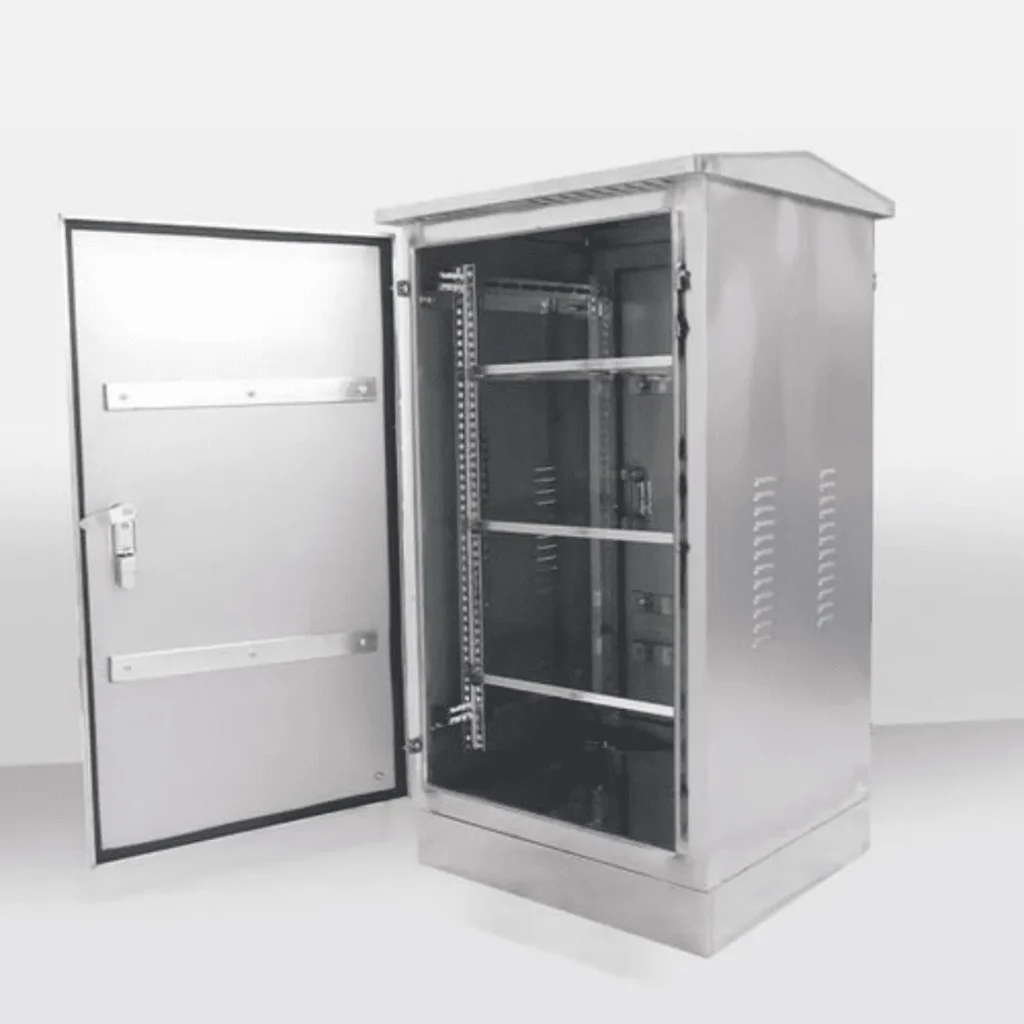
Cooling begins with identifying where heat is generated and how it can be removed. In an outdoor network cabinet, the thermal path usually involves internal equipment heat, cabinet airflow, cabinet wall heat transfer, outdoor ambient air, and solar heat gain.
A practical engineering workflow is:
- List all installed equipment.
- Determine equipment quantity and power consumption.
- Estimate or calculate the total internal heat load.
- Review maximum and minimum ambient temperature.
- Evaluate direct solar exposure and cabinet orientation.
- Define the required internal temperature range.
- Review dust, humidity, salt spray, rain, and IP protection requirements.
- Compare ventilation, fan cooling, and outdoor telecom cabinet cooling options.
- Design the internal airflow path.
- Add sensors, controls, alarms, or heating functions where required.
Natural ventilation and fan systems depend heavily on the quality and temperature of the outside air. If the outside air is already hotter than the required equipment intake condition, more airflow alone may not solve the problem. An outdoor cabinet air conditioner can provide active cooling, but it also increases cost, power demand, and maintenance requirements.
ShiRui Pro Tip: I never evaluate cooling from cabinet volume alone. I look at heat load, ambient temperature, solar exposure, and airflow path first, then select the cooling method that matches the real operating environment.
Where is the best place to put a fan to cool a room?
For an outdoor network cabinet, the best fan position is not simply “top” or “bottom”; it is where the fan supports a complete airflow path through the heat-producing equipment. Cooler intake air should pass through critical devices before heated air exits, without short-circuiting directly from intake to exhaust.
Fan Placement and Airflow Direction
In cabinet design, fan placement must guide air through the equipment zone. A poorly placed fan may move air without cooling the most important components. This is especially common when an intake and exhaust are too close together or when cables block the intended airflow path.
Good outdoor network cabinet fan cooling design should consider:
- Intake location relative to equipment air inlets
- Exhaust location relative to hot-air discharge zones
- Equipment airflow direction, such as front-to-back or side-to-side
- Cable routing that does not block air movement
- Filter position and maintenance access
- Avoidance of airflow short circuits
- Separation between cool supply air and hot return air
- Sensor placement in representative thermal zones
A useful cabinet airflow concept is:
- Filtered outdoor air enters the intake.
- Air passes through or across network equipment.
- Heated internal air moves toward the exhaust path.
- Exhaust fan discharges warm air outside.
- Temperature control activates fans only when project logic requires it.
The best location depends on the cabinet layout, equipment orientation, rack structure, and site environment.
ShiRui Pro Tip: I avoid placing fans where they only cool empty cabinet space. The fan should serve the equipment, not just create visible airflow at the vent.
Does fan mode on AC make it colder?
Fan mode on an AC does not provide active refrigeration by itself. In an outdoor network cabinet, fan-only operation moves air and improves heat distribution, but it does not cool below the temperature of the air being circulated or introduced. Active cooling requires the air conditioner’s refrigeration function to operate.
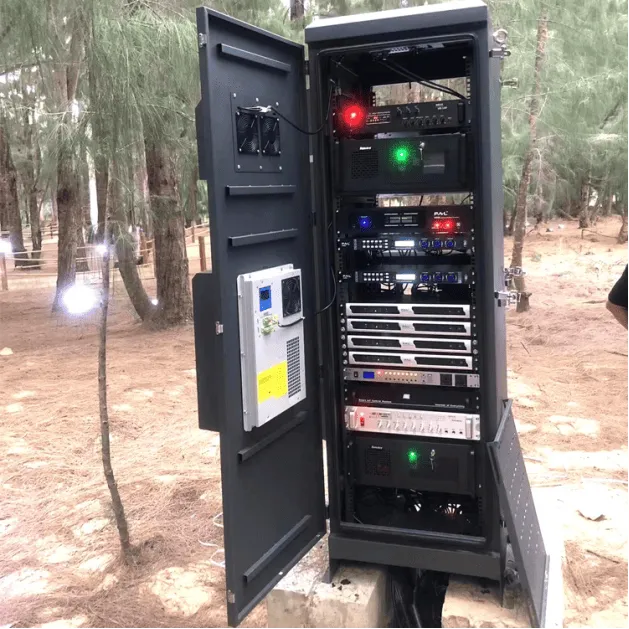
Fan Mode Versus Active Cooling
This distinction is critical for temperature controlled network cabinet design. A fan can increase air movement, reduce localized hot spots, and improve heat transfer, but it cannot create colder air. An outdoor cabinet air conditioner, when operating in cooling mode, actively removes heat from the protected internal space and rejects it outside.
Based on our internal data and market analysis, here is the breakdown:
| Function | Fan Mode | Active AC Cooling |
|---|---|---|
| Refrigeration effect | No | Yes |
| Main role | Air circulation | Heat removal |
| Ability to cool below ambient | No | Possible, depending on system design |
| Dust exposure | Depends on airflow design | Can be reduced in isolated designs |
| Power demand | Lower | Higher |
| Temperature control strength | Limited | Stronger |
| Suitability | Air mixing or ventilation support | Demanding thermal-control applications |
For outdoor cabinet air conditioning, internal airflow still matters. If cold supply air returns directly to the AC without passing through network equipment, the cabinet can still develop hot spots.
ShiRui Pro Tip: I remind customers that fan mode is not a substitute for refrigeration. If the project requires controlled internal temperature under high outdoor heat, we must evaluate active cooling, not just add more fans.
Why is my room still hot with two fans?
A space or cabinet can remain hot with two fans if the fans are recirculating warm air, fighting each other, bypassing the equipment, pulling in hot outdoor air, or operating in an environment where ambient temperature is already too high. More fans do not automatically mean better cooling performance.
Common Reasons Fans Do Not Solve Heat
In outdoor network cabinet ventilation, fan quantity is less important than thermal design. A cabinet may still overheat if the airflow path is incomplete, filters are restrictive, solar heat gain is high, or equipment produces more heat than the airflow strategy can remove.
Common causes include:
- Fans create a short path from intake to exhaust.
- Critical equipment receives little airflow.
- Equipment fans oppose cabinet airflow direction.
- Filters are undersized, clogged, or too restrictive.
- Outdoor air temperature is already unsuitable.
- Solar exposure adds heat beyond the internal equipment load.
- Hot exhaust air is recirculated into the intake.
- Cable bundles block air movement.
- Sensors are placed in unrepresentative locations.
- The cabinet IP requirement limits ventilation openings.
A fan cannot cool the cabinet below the temperature of the air being brought into the cabinet. If the site has high ambient temperature, dust, sand, humidity, or salt spray, fan cooling may require careful filtration or a more isolated thermal-management strategy.
ShiRui Pro Tip: When a customer says “we already added more fans,” I check airflow direction, intake temperature, filter resistance, and hot-air return paths before recommending larger fans.
Key Features & Comparison
Natural ventilation, fan cooling, and industrial air conditioning each solve different outdoor network cabinet cooling problems. Natural ventilation is simple and low-power, fan cooling increases air exchange, and industrial AC provides active temperature control. The best choice depends on heat load, ambient temperature, solar gain, contamination risk, and protection requirements.
Cooling Method Selection Matrix
Based on our internal data and market analysis, here is the breakdown:
| Factor | Natural Ventilation | Fan Cooling | Industrial AC |
|---|---|---|---|
| Active cooling | No | No refrigeration | Yes |
| Outside-air dependence | High | High | Lower |
| Heat-load capability | Lower | Moderate | Higher |
| Dust exposure | Higher | Depends on filtration | Can be reduced |
| Temperature control | Limited | Limited | Stronger |
| Power consumption | Lowest | Low | Higher |
| Maintenance | Lower | Fan/filter maintenance | AC maintenance |
| Sealed cabinet potential | Limited | Limited | Better suited to isolated designs |
| Hot climate suitability | Limited | Depends on ambient temperature | Often worth evaluating |
| Cost level | Lower | Moderate | Higher |
| IP protection impact | Openings require careful design | Openings and filters require careful design | Depends on complete cabinet configuration |
| Solar heat gain response | Limited | Limited by ambient air | Can be engineered into capacity selection |
| Dusty site performance | Challenging | Filter-dependent | Often worth evaluating |
| Humidity considerations | Outside air enters cabinet | Outside air enters cabinet | Condensation control must be considered |
Natural ventilation may be suitable for low internal heat loads and favorable environments. Fan cooling may be suitable when outside air can safely remove heat and filtration is manageable. Industrial air conditioning may be considered when the cabinet requires stronger temperature control, reduced outside-air exchange, or operation in more demanding climates.
ShiRui Pro Tip: I do not present AC as automatically “better.” I compare the thermal load, environment, maintenance ability, and required protection level, then choose the simplest system that can reliably meet the project conditions.
Cost & Buying Factors
The cost of outdoor network cabinet cooling depends on the selected cooling method, cabinet structure, environmental protection level, controls, sensors, maintenance access, corrosion protection, and project location. Natural ventilation is generally lower cost, fan cooling is moderate, and industrial air conditioning usually requires higher investment and electrical planning.
What Buyers Should Evaluate Before Purchasing
Pricing cannot be determined accurately from cabinet dimensions alone. A large outdoor network cabinet with low-power equipment may need less cooling than a smaller cabinet with dense PoE switching, UPS equipment, and power electronics.
Buyers should provide the following information before selecting a cooling system:
- Equipment list
- Equipment quantity
- Equipment power consumption
- Estimated heat load, where available
- Cabinet size or rack requirement
- Maximum ambient temperature
- Minimum ambient temperature
- Humidity conditions
- Dust or sand exposure
- Coastal or salt-spray conditions
- Direct solar exposure
- Required internal temperature
- Required IP rating
- Operating hours
- Power supply conditions
- Installation method
- Project location
- Maintenance access conditions
A practical selection workflow is:
- Confirm equipment and heat load.
- Review climate and installation environment.
- Evaluate solar gain and cabinet exposure.
- Define internal temperature requirements.
- Decide whether outside air can safely enter.
- Compare natural ventilation, fan cooling, and industrial AC.
- Design airflow and equipment layout.
- Add filters, louvers, seals, sensors, or controls as required.
- Verify that the complete cabinet meets protection and performance goals.
Cost should include not only purchase price, but also power consumption, maintenance, filter access, installation complexity, spare parts, and downtime risk.
ShiRui Pro Tip: I ask customers to share project location and equipment power data early. This avoids selecting a low-cost cooling option that later fails because the environment or heat load was underestimated.
Conclusion
The correct outdoor network cabinet cooling method depends on total heat load and environment. Natural ventilation, fan cooling, and industrial air conditioning all have valid applications. The right engineering choice considers equipment power, ambient temperature, solar exposure, humidity, dust, IP protection, operating schedule, and maintenance conditions before hardware is selected.
Practical Engineering Takeaway
Do not choose outdoor network cabinet cooling by cabinet size alone. Cabinet size affects layout, airflow space, and surface area, but it does not define the thermal load. The installed equipment and outdoor environment determine the real cooling requirement.
A reliable decision framework is:
- Use natural ventilation when the heat load is low and outdoor conditions are suitable.
- Use fan cooling when active air exchange is enough and outside air quality is manageable.
- Use industrial air conditioning when active temperature control or reduced outside-air exchange is required.
- Consider heating if the cabinet operates in low-temperature environments.
- Consider humidity, condensation, and corrosion in coastal or high-humidity locations.
- Coordinate airflow design with equipment layout and airflow direction.
- Place sensors where they represent actual equipment conditions.
- Verify IP protection as part of the complete cabinet configuration.
ShiRui supports outdoor network cabinet projects with custom sheet-metal enclosure design, ventilation structures, fan cooling layouts, air conditioner integration, filtering, sealing, sensor placement, and project-specific thermal-management planning.
ShiRui Pro Tip: My final recommendation is always the same: calculate the heat, study the environment, then choose the cooling method. Fans move heat; air conditioners actively remove heat; neither should be selected by cabinet size alone.