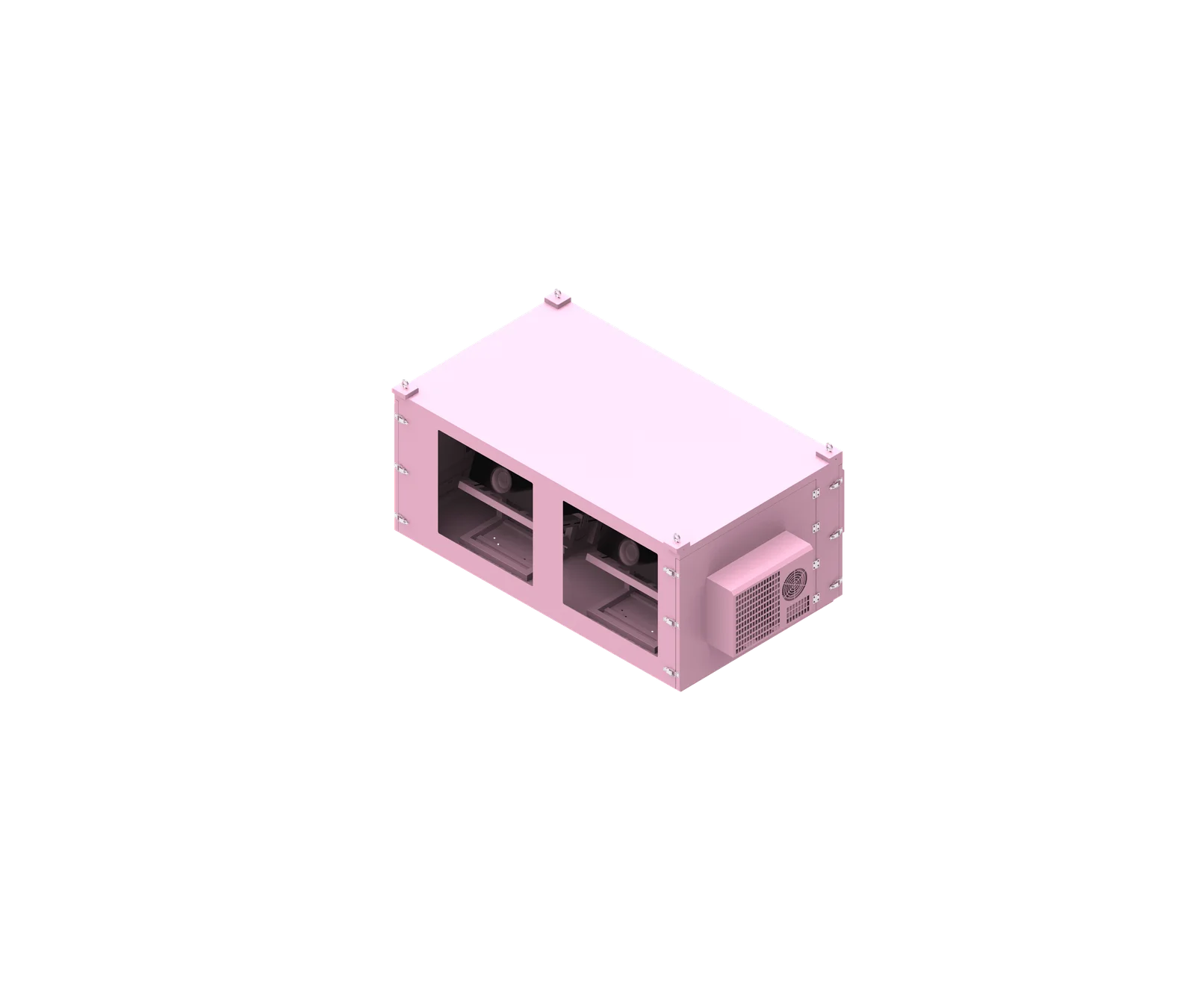
An airflow visualization smoke test makes invisible air movement visible inside an outdoor projector enclosure. Using safe, non-flammable tracer fog or purpose-designed airflow visualization equipment, engineers can see whether cooling air reaches the projector intake, whether hot exhaust leaves correctly, and whether recirculation, short circuits, or stagnant zones exist. It is a diagnostic method, not a fire, IP rating, dust, or full thermal certification test.
Video Guide: See how an outdoor enclosure for projector applications is evaluated through smoke testing. The video shows airflow movement inside the enclosure and provides a practical reference for assessing ventilation and enclosure performance in professional outdoor projection systems.
What is projector enclosure smoke test?
A projector enclosure smoke test is an airflow visualization method used to observe how air moves inside an outdoor projector enclosure. It introduces safe tracer fog near airflow paths so engineers can confirm intake flow, exhaust removal, fan performance, AC supply behavior, and possible recirculation around the projector.
Airflow Visualization Purpose
A projector enclosure smoke test does not test whether the enclosure can survive fire, block rain, or meet an IP rating. In this context, “smoke” means a safe visible tracer used to reveal airflow behavior inside a working enclosure layout.
The purpose is to answer a practical engineering question: is the actual air path supporting the projector’s cooling needs?
A smoke test can help visualize:
- Air intake direction
- Projector intake airflow
- Projector exhaust airflow
- Enclosure fan airflow
- Air-conditioner supply airflow
- Air-conditioner return airflow
- Recirculation near the projector
- Turbulence around brackets or panels
- Stagnant zones in corners or behind components
- Airflow short circuits between supply and return openings
The test is especially useful because fan operation alone does not prove effective cooling. A fan may spin normally while air bypasses the projector, hot exhaust returns to the intake, or conditioned air flows directly back to an AC return without cooling the projector.
ShiRui Pro Tip: I always treat a smoke test as a visibility tool, not a pass/fail certificate. If the tracer shows air moving in the wrong direction, the enclosure layout should be corrected before relying on temperature testing alone.
How Does projector enclosure smoke test Work?
A projector enclosure smoke test works by introducing safe tracer fog near the intended airflow path, then observing where it travels. Engineers typically check the projector intake, follow airflow through the projector zone, inspect exhaust movement, and look for recirculation, stagnant zones, or cooling-air short circuits.
Video Guide: Get a closer look at an outdoor projector enclosure designed for professional AV and projection projects. This video presents the enclosure structure and shows how a dedicated housing solution can support projector equipment in permanent outdoor installations, commercial venues, and large-scale projection applications.ing tested.
Step-by-Step Airflow Path Verification
The test should be performed with the enclosure assembled as close as practical to its real operating configuration. Testing an empty cabinet can be misleading because the projector, filters, brackets, cable bundles, doors, panels, optical window, and cable glands can all change airflow behavior.
A recommended workflow is:
- Confirm the projector model, intake locations, exhaust locations, and cooling requirements.
- Define the expected airflow path through the enclosure.
- Assemble the enclosure in a realistic operating configuration.
- Install normal filters, panels, brackets, cables, and cooling components.
- Close service doors if the enclosure normally operates closed.
- Run the fans or air conditioner in the intended operating mode.
- Introduce safe, equipment-compatible tracer fog near the airflow source or projector intake.
- Observe whether cooler air reaches the projector intake.
- Follow the visible airflow through the projector zone.
- Check whether projector exhaust moves away efficiently.
- Look for smoke returning toward the projector intake.
- Inspect corners, rear zones, cable bundles, and bracket areas for stagnant airflow.
- Check AC supply and return interaction if the enclosure is air-conditioned.
- Document observations with notes, photos, or video.
- Modify the airflow design if needed, then re-test.
The intended airflow path often looks like this:
Cooling or conditioned air
→ projector intake
→ projector cooling system
→ projector exhaust
→ enclosure exhaust or cooling-system return
The smoke test helps determine whether the actual flow follows this path or takes an unintended shortcut.
ShiRui Pro Tip: I prefer starting at the projector intake because it is the most critical location. If the projector is pulling in its own hot exhaust, the enclosure may look ventilated while the projector is still thermally stressed.
What are the benefits of projector enclosure smoke test?
The main benefit of a projector enclosure smoke test is that it reveals airflow problems engineers cannot see from fan operation alone. It helps identify hot-air recirculation, blocked intakes, poor exhaust paths, AC short circuits, stagnant hot zones, cable obstruction, and airflow conflicts in multi-projector enclosures.
Problems Made Visible by Tracer Fog
Fan status tells you that a fan is operating; it does not prove that air reaches the projector correctly. A smoke test provides visual evidence of the actual airflow route inside the enclosure.
Based on our internal data and market analysis, here is the breakdown:
| Smoke Test Observation | What It May Indicate |
|---|---|
| Air reaches projector intake | Intended supply path is working |
| Exhaust moves directly away | Good heat-removal path |
| Smoke returns to intake | Hot-air recirculation |
| Smoke barely moves | Stagnant airflow zone |
| AC air goes straight to return | Cooling-air short circuit |
| Smoke stops at cable bundle | Cable obstruction |
| One projector receives another’s exhaust | Multi-projector airflow conflict |
For fan-cooled outdoor projector enclosures, the test can confirm whether outside air moves through the filter, fan, projector intake, projector exhaust, and enclosure exhaust in a logical sequence.
For air-conditioned projector enclosures, the test can show whether cooled supply air actually reaches the projector or simply returns to the air conditioner through a short path.
For dual-projector or multi-projector systems, smoke visualization is especially valuable because one projector’s exhaust can unintentionally enter another projector’s intake.
ShiRui Pro Tip: In multi-projector enclosures, I check each projector separately. A shared cabinet can hide uneven airflow, where one projector receives clean cooling air while another receives heated exhaust from its neighbor.
How to maintain a projector enclosure smoke test?
Maintaining the value of a projector enclosure smoke test means repeating airflow verification whenever the enclosure configuration changes. Cable routing, filter condition, projector model, fan placement, AC layout, brackets, and internal panels can all alter airflow, so the test should be documented and updated as the system evolves.
Re-Testing and Documentation Discipline
A smoke test is not a one-time ritual. It is most useful when treated as part of an ongoing design and validation process, especially for custom outdoor projector enclosures where internal layouts vary by project.
Re-test airflow after major changes such as:
- A different projector model
- A changed projector position
- New fan placement
- A new air conditioner
- Different filters
- Updated cable routing
- Added electrical components
- Revised internal brackets
- Added internal panels or partitions
- Conversion from single-projector to multi-projector layout
- Changes to optical window position or service-door structure
Useful test records include:
- Projector model
- Projector quantity
- Final enclosure configuration
- Cooling method
- Fan configuration
- Filter configuration
- Cable routing
- Tracer introduction point
- Observed airflow direction
- Recirculation areas
- Stagnant zones
- Photos or video records
- Design changes made after testing
The test should be performed with normal filters installed. Removing filters can create an airflow pattern that does not represent real operation because filter resistance affects pressure and airflow direction.
ShiRui Pro Tip: I always document the enclosure exactly as tested. If someone later moves a cable bundle, changes a filter type, or adds a control box, the previous smoke test may no longer represent the real airflow condition.
What is the price of projector enclosure smoke test?
The price of a projector enclosure smoke test depends on project complexity, enclosure size, cooling method, projector quantity, documentation needs, and whether testing is done in-house, by the enclosure manufacturer, or by an independent engineering service. There is no universal price because test scope varies significantly.
Cost Drivers and Scope Variables
A simple visual airflow check on a single-projector enclosure requires less planning than a formal evaluation of a multi-projector, air-conditioned outdoor cabinet with detailed documentation.
Based on our internal data and market analysis, here is the breakdown:
| Cost Factor | Why It Affects Price |
|---|---|
| Projector quantity | Multiple projectors require individual airflow checks and interaction analysis |
| Cooling method | Fan-cooled and air-conditioned systems require different observation points |
| Enclosure complexity | Brackets, panels, filters, and cable routing increase test variables |
| Documentation level | Photos, video, engineering notes, and reports add time |
| Test location | Factory, lab, or installation-site testing may have different logistics |
| Required instruments | Smoke visualization, anemometers, and thermal imaging may change scope |
| Design iteration | Re-testing after modifications adds engineering effort |
A buyer requesting an outdoor projector enclosure airflow test should provide:
- Exact projector model
- Projector quantity
- Intake and exhaust locations
- Projector power consumption data
- Cooling method
- Internal layout drawings if available
- Filter configuration
- Cable routing plan
- Installation environment
- Maximum design ambient condition required by the project
- Operating schedule
- Any space limits around the enclosure
The most accurate pricing usually comes after the enclosure supplier understands both the mechanical design and the expected verification depth.
ShiRui Pro Tip: I recommend asking for the smoke test scope, not just the price. A low-cost visual check and a documented engineering airflow review are very different services.
Key Features & Comparison
A well-planned projector enclosure smoke test focuses on airflow path confirmation, not dramatic smoke movement. The key features include safe tracer use, realistic enclosure configuration, closed-door testing where applicable, intake and exhaust observation, recirculation detection, stagnant-zone identification, and integration with temperature verification.
Diagnostic Capabilities Compared
Based on our internal data and market analysis, here is the breakdown:
| Verification Method | What It Shows | What It Does Not Prove | Best Use |
|---|---|---|---|
| Projector enclosure smoke test | Where air moves inside the enclosure | Final cooling capacity or safe operating temperature | Visualizing intake, exhaust, recirculation, and short circuits |
| Anemometer measurement | Air velocity or airflow at selected points | Complete airflow pattern throughout the enclosure | Quantifying airflow at critical openings or locations |
| Temperature measurement | Actual temperatures at selected points | Exact airflow route causing the temperature pattern | Confirming intake, exhaust, and internal thermal conditions |
| Thermal imaging | Surface temperature distribution and hot zones | Internal airflow direction by itself | Locating hot surfaces and uneven heat accumulation |
| IP testing | Water or dust ingress protection performance | Cooling airflow effectiveness | Verifying environmental sealing against defined standards |
| Fire testing | Fire-related material or system performance | Ventilation performance or projector cooling | Fire-safety validation when required by applicable standards |
A smoke test should be combined with other methods when the project requires stronger validation. Smoke visualization answers, “Where is the air going?” An anemometer helps answer, “How much or how fast is air moving here?” Temperature logging helps answer, “Is the projector operating within the required thermal range?”
Together, these methods provide a more complete understanding of enclosure cooling performance.
ShiRui Pro Tip: I never use smoke movement alone as proof of thermal safety. If smoke shows the correct airflow path, the next step is still temperature measurement under realistic operating conditions.
Cost & Buying Factors
When buying or specifying a projector enclosure smoke test, the most important factors are test scope, equipment safety, enclosure realism, cooling-system type, documentation requirements, and engineering follow-up. The goal is to confirm airflow performance in the final operating configuration, not simply to create visible smoke inside a cabinet.
What Buyers Should Confirm Before Testing
A professional outdoor projector enclosure airflow test should be planned around the actual projector and enclosure design. The supplier or engineering team needs accurate project information to evaluate airflow properly.
Before requesting testing, confirm:
- The exact projector model and physical orientation.
- The projector’s intake and exhaust locations.
- Whether the enclosure is fan-cooled, air-conditioned, or hybrid-cooled.
- Whether the enclosure contains one projector or multiple projectors.
- The final cable routing plan.
- The filter type and installed filter configuration.
- The locations of internal brackets, rails, panels, and electrical components.
- Whether the enclosure normally operates with doors closed.
- The installation environment and expected operating conditions.
- The level of documentation required.
- Whether additional temperature testing is required.
- Whether design modifications and re-testing are included.
Safe test methods may include purpose-designed airflow smoke equipment, non-flammable tracer fog, or other equipment-appropriate visualization tools. The method should be compatible with projector optics, optical glass, filters, sensors, electronic components, and enclosure materials.
Open flames, cigarettes, burning paper, combustible smoke sources, or uncontrolled smoke should not be used around projectors, electrical components, or optical systems.
ShiRui Pro Tip: I advise buyers to ask whether the test will be done with the final filters, cables, doors, and projector installed. If those items are missing, the airflow pattern may not represent real operation.
Conclusion
A projector enclosure smoke test is a practical airflow diagnostic tool for outdoor projector enclosures. It makes invisible airflow visible, helping engineers confirm that cooling air reaches the projector, hot exhaust leaves effectively, and problems such as recirculation, short circuits, obstructions, and stagnant zones are identified before final validation.
Practical Engineering Takeaway
A smoke test is valuable because it reveals the actual behavior of air inside the enclosure. This is critical for outdoor projector systems, where the cabinet must protect the projector while still supporting effective heat removal.
However, it should not be confused with:
- Fire-resistance testing
- Fire-safety certification
- IP waterproof testing
- Dust-ingress testing
- Electrical safety testing
- Structural testing
- Full thermal validation
A complete verification process may include:
- Confirming projector airflow requirements.
- Defining the intended airflow path.
- Assembling the realistic enclosure configuration.
- Running fans or AC systems as designed.
- Introducing safe airflow tracer.
- Observing the projector intake.
- Following airflow through the projector zone.
- Checking exhaust removal.
- Detecting recirculation or stagnant zones.
- Measuring relevant temperatures.
- Modifying the airflow design if needed.
- Re-testing after changes.
- Documenting the final results.
For custom outdoor projection projects, ShiRui can help evaluate enclosure layout, cooling strategy, and airflow verification needs so the final design supports the projector’s real operating requirements.
ShiRui Pro Tip: The goal is not simply to see smoke move. The goal is to prove that the airflow path makes engineering sense for the projector, the enclosure, and the outdoor environment where the system will operate.